Mirage of hyper-inflated valuation for SMEs and mid-market businesses
Anirvan Sen · November 2026
◆
I have spent decades around businesses of every size, and one thing still catches me off guard. Perfectly ordinary companies, sitting well below $10 to $15 million in revenue, are being priced by their owners as if they were category-defining platforms. Not at a multiple of earnings. At a multiple of revenue.
Two recent conversations illustrate the point.
Two Law Firms, Two Extraordinary Expectations
The first was a UK law firm with roughly £3 million in annual revenue. The owner’s representative told me the firm should fetch one and a half to two times revenue, somewhere between £4.5 and £6 million. When I asked about profitability, the numbers I heard back were, to put it politely, creative. This was not a firm with a thriving corporate or M&A practice, the kind of work where law firms make extraordinary money. It was a respectable, ordinary practice. When I tried to explain how the market values firms like it, the representative wasn’t interested in listening.
The second case was larger and, in some ways, more revealing. This was a firm of eleven partners with roughly £18 million in annual revenue, and profitability that did not come close to supporting the story being told. Each partner expected £2 million. Not as an earnout. Not over time. On day one.
Do the arithmetic. That is £22 million in cash at closing, more than the firm’s entire annual revenue, before a single pound of deferred consideration is even discussed. And every pound of future risk would sit with the buyer. If revenue softened, if clients drifted, if partners lost interest the morning after the money arrived, none of it would be the sellers’ problem.
I have seen versions of this pattern again and again. These are not isolated cases. They are a symptom of something every founder-led business that wants to scale, and eventually exit, needs to understand.
Revenue Is Not Value
Revenue is the most flattering number in any business. It is visible, easy to communicate, and psychologically impressive. When an owner has spent twenty years building a firm that turns over £3 million, that figure feels like the scoreboard.
But a buyer is not purchasing your scoreboard. A buyer is purchasing a future stream of cash, and paying for the confidence that it will keep arriving once you are no longer the one generating it. Revenue says nothing about how much of that revenue turns into cash, how dependable it is, or how much of it walks out the door with the founder.
Revenue multiples do exist, and in certain sectors and business models they are entirely legitimate. But a revenue multiple is not an entitlement that comes with having revenue. You earn it through margins, recurring income, scalability, and growth that doesn’t depend on one person’s effort. Most ordinary SMEs have not earned it.
Where the $30 Million Number Comes From
When I look for the source of these expectations, I find the same five contributors.
The first is headline contamination. Owners read about extraordinary transactions and never see the economics behind them. A strategic buyer paying a staggering multiple for a rare, high-growth asset becomes, in the owner’s mind, a reference point for a perfectly normal business.
The second is advisor amplification. Some intermediaries tell owners what they want to hear because an inflated valuation wins the mandate. I would not suggest every intermediary behaves this way, but I have watched enough of them reinforce a number rather than test it.
The third is emotional ownership. Decades of sacrifice, sleepless nights, and personal risk get quietly converted into a financial premium. The market does not pay for effort. It pays for future returns.
The fourth is comparability blindness. Owners assume their company deserves the multiples achieved by businesses that look nothing like theirs in scale, growth, or margin profile.
The fifth, and the most powerful, is exit arithmetic. The owner decides what they need to retire comfortably, then works backward to a valuation that delivers it. That is a financial plan. It is not a valuation methodology.
The Other Delusion: Tomorrow’s Value, Paid Today, With No Tomorrow’s Risk
The second law firm taught me something beyond overvaluation.
Valuation and payment structure are two entirely separate negotiations. Even if a buyer accepts the headline number, that doesn’t mean they should pay the full amount at closing. In a partner-driven professional services firm, the revenue exists because particular people hold particular client relationships. Those partners are, in a very real sense, the asset.
Now consider what eleven partners were asking for. Full payment on day one, before they had to prove anything about continuity, retention, or performance. A buyer would reasonably ask what exactly they are acquiring if the individuals who generate the revenue have already received their entire reward, with no meaningful reason to stay engaged.
Deferred consideration, earnouts, rollover equity, and retention arrangements exist for exactly this reason. They are not insults. They are how buyers and sellers share risk when the future depends on the sellers. An all-cash, upfront deal is not unreasonable in itself, and in the right circumstances it is perfectly sensible. The problem arises when substantial continuity risk remains, and the sellers reject every mechanism designed to address it.
In short, these owners did not merely overestimate what their companies were worth. They underestimated how much of that value depended on their own continued involvement.
Why Owners Will Not Listen
This is the part that fascinates me most, because by this stage the problem is no longer financial. It is behavioral.
An owner develops an expectation. An intermediary reinforces it. The expectation hardens into an anchor. Evidence that contradicts it gets dismissed, and a candid market assessment gets reinterpreted as an attempt to lowball the business. Once that happens, the owner has lost the ability to negotiate on commercial terms, because every piece of buyer feedback feels like disrespect.
Knowing how to build and run a business is not the same as knowing how to value and sell one. Many founders can tell you their revenue, their headcount, and their best clients. Far fewer can explain their sustainable cash earnings, the risk a buyer would price in, or why their company deserves a premium over the next one.
The Price of Being Wrong
An unrealistic valuation is expensive, and the cost compounds.
Serious buyers walk away before doing meaningful diligence, because they can see within minutes that the gap is unbridgeable. Processes drag on. Management attention drifts from running the business to managing a sale that is going nowhere. Favorable market windows close. Repeated failed attempts create market fatigue, and a business that has been shopped around unsuccessfully looks tired to the next buyer.
Eventually the owner accepts worse terms than they were once offered, or abandons the transaction altogether. The longer an unrealistic number survives, the more it costs.
What This Means for Scaling
This is why the topic belongs in a conversation about scaling. Businesses that command genuine premiums have scaled beyond their founders: management that operates independently, revenue that is repeatable rather than relationship-dependent, and margins that hold as the business grows. A good business is not automatically an attractive acquisition. A profitable SME can be a wonderful source of income for its owner and an unremarkable investment for everyone else.
Scaling closes that gap. It turns a business that depends on you into one that does not, and that is the only version a buyer will pay a premium for.
A Reality Check Before You Name a Number
If you are considering a sale, take these five steps before you ever state a price.
Understand your normalized earnings, your cash generation, and the quality of those earnings, including how partner or owner compensation is treated, which matters enormously in professional services. Study genuinely comparable transactions, with honest attention to differences in scale, growth, and risk. Identify where your business is truly differentiated and where it is simply ordinary. Seek independent perspectives, including a buyer-side view. And separate your personal financial goals from your company’s commercial value, because the first has no bearing on the second.
You can choose the price you ask for your business. You cannot choose the value the market assigns to it.
◆ ◆ ◆
ABOUT THE AUTHOR
Anirvan Sen is a business strategist, author, and CEO and Founder of Fifth Chrome — advising CEOs, PE investors, family offices, and Fortune 500 organizations on strategy, leadership, transformation, and M&A. He created the Buy-and-Build Operating System framework and has written multiple books on M&A, leadership, strategy, and organizational design.
Where This Conversation Can Go Next
The ideas discussed here are part of the work we do at Fifth Chrome through SCALEUP, Sales Enablement – TRAITS, and our Buy-and-Build Operating System—designed for leaders serious about building businesses that can scale, integrate, and compound.
If this resonates and you believe a deeper conversation would be valuable, you can reach us at SCALEUP@fifthchrome.com.
About Fifth Chrome
At Fifth Chrome, we help companies unlock unprecedented opportunities through M&A, buy-and-build, scaling up, and leadership strategies. Whether you’re a Fortune 500 company, a mid-cap, or an SME, our expertise in M&A integration, leadership development, and strategic advisory services can help you achieve scalable growth with precision and speed.
Contact Us
Visit us at fifthchrome.com for more information on our services or to schedule a consultation.
Ready to Go Deeper?
Want to dive deeper into the stages of growth, their corresponding structures, leadership styles, and operating models?
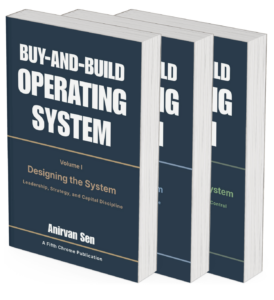
Then this book might be for you: Buy-and-Build Operating System, 3-volume set, available on all Amazon sites globally.
Visit Amazon in the US, UK, DE, FR, ES, IT, NL, JP, BR, CA, MX, AU, PL, SE, BE, IE, or IN to get your copy today.