What Scaling Businesses Really Demand of an HR Leader
Anirvan Sen · September 2026
◆
Every buy-and-build platform assumes its biggest constraint will be capital, customers, or the next acquisition. In my experience advising these platforms, that assumption is usually wrong. The real constraint, more often than not, is talent and leadership capability — and the function best positioned to address it, HR, is still too often treated as an administrative afterthought rather than a central part of the growth conversation.
That is the tension worth sitting with before any platform sets out to scale: if people and leadership are fundamental to growth, why is HR so often positioned at the edge of that conversation rather than at its center?
What Business Are We Trying to Become?
The traditional HR conversation tends to start with people processes — recruiting, payroll, benefits, policy. The scaling conversation has to start somewhere else entirely: what business are we trying to become?
Once that future state becomes clearer, a series of people questions follows. What organization does the business need? What leadership does that organization require? What capabilities do the leaders need? What talent already exists inside the business? What has to be developed, recruited, retained, redeployed, or replaced? And what systems will let that organization actually operate?
That sequence changes what HR is for. The function moves from managing the people processes that already exist to helping translate business strategy into organizational capability. That shift is the larger story behind everything else in this piece.
Talent and Leadership Become the Constraint
Businesses routinely grow faster than their people systems mature. Revenue increases. Customers increase. Locations increase. Acquisitions increase. Complexity increases along with all of it. But the leadership team that successfully ran a smaller organization is often the same team suddenly expected to run a much larger and more complex one.
That creates a fairly uncomfortable question: can the leadership team scale as quickly as the business? A platform can have plenty of capital to acquire the next business. It can have plenty of commercial opportunity to double revenue. But without leaders capable of running the resulting organization, people capability becomes the ceiling on growth—making talent development a growth issue long before it becomes an HR issue.
The Role Has to Evolve, Not Just Grow
The HR function that suits a fifty-person business rarely suits a five-hundred-person one. The function supporting a single company is rarely sufficient for a group that has absorbed five acquisitions. As scale increases, the role has to move along several dimensions at once.
It has to move from reactive to anticipatory — identifying tomorrow’s capability gaps instead of only responding to today’s people problems. From processing transactions to shaping decisions — helping leaders make better calls about people and structure, not simply administering the ones already made. From focusing on individuals to focusing on the organization itself — asking not only who to hire, but whether the structure they are being hired into is the right one. From policies to capability, because policy alone never built leadership capacity. And from HR metrics to business outcomes — connecting turnover, productivity, and leadership strength to what the business is actually trying to achieve. Underneath it all sits the biggest shift: from a support function to an enabling one.
Administrative Excellence and Strategic Contribution
None of that means the fundamentals disappear. Payroll still has to run. Benefits still have to be managed. Compliance, employee relations, recruiting, and policy do not become optional as the organization scales. The real challenge is not administrative HR or strategic HR. It is administrative excellence and strategic contribution, sustained at the same time.
That combination is one of the hardest transitions the function goes through. It is considerably easier to be reliably administrative, or strategically ambitious, than to do both simultaneously while the business underneath you keeps changing shape.
HR as an Enabler of Strategy
Strategy tells a business where it wants to go. Whether the organization can actually get there is a different question entirely — and increasingly, it is HR’s question to answer. A growth strategy typically requires different leadership capability, new technical expertise, additional management layers, clearer decision rights, and more professionalized processes than the business currently has. Without those organizational capabilities, the strategy stays exactly that: a strategy, not yet a business.
Buy-and-Build Raises the Stakes
Organic scaling already creates real people complexity. Buy-and-build multiplies it. Every acquisition brings its own leadership team, organizational structure, compensation philosophy, culture, and decision-making style. The acquiring platform has to work out, acquisition by acquisition, what to preserve, what to integrate, what to standardize, and what to leave alone.
That decision sits squarely in HR’s lane — or at least, it should. In practice, I have seen HR brought into the acquisition conversation only after the deal has closed, by which point several important questions have often already gone unasked: who the critical people actually are, where the retention risk sits, what the compensation gaps look like, and which leadership roles now overlap. People decisions materially affect whether an acquisition’s value ever shows up, which is exactly why they should not begin as a post-close exercise.
Are You Scaling Revenue Faster Than the Organization?
Businesses tend to measure their own scaling through revenue, EBITDA, acquisitions, customers, headcount, and valuation. Those numbers move quickly, and they are easy to report. Leadership capacity, management systems, organizational structure, and talent depth move more slowly, and they are much harder to put in a board deck—which is exactly why they tend to lag.
For a while, a business can outrun that gap. Eventually it catches up: leaders become overloaded, decisions slow down, delegation weakens, turnover rises, and the business grows more dependent on a handful of individuals holding the whole thing together by memory. What looks like an HR problem at that point is usually something else entirely — evidence that the operating model never kept pace with the growth it was meant to support.
The question worth asking before that gap opens is not whether the business is scaling. It is whether the organization is scaling with it.
◆ ◆ ◆
This article was inspired by the Podcast/YouTube with Michelle Kaihani: YouTube, Spotify, Apple Podcast
◆ ◆ ◆
ABOUT THE AUTHOR
Anirvan Sen is a business strategist, author, and CEO and Founder of Fifth Chrome — advising CEOs, PE investors, family offices, and Fortune 500 organizations on strategy, leadership, transformation, and M&A. He created the Buy-and-Build Operating System framework and has written multiple books on M&A, leadership, strategy, and organizational design.
Where This Conversation Can Go Next
The ideas discussed here are part of the work we do at Fifth Chrome through SCALEUP, Sales Enablement – TRAITS, and our Buy-and-Build Operating System—designed for leaders serious about building businesses that can scale, integrate, and compound.
If this resonates and you believe a deeper conversation would be valuable, you can reach us at buyandbuild@fifthchrome.com.
About Fifth Chrome
At Fifth Chrome, we help companies unlock unprecedented opportunities through M&A, buy-and-build, scaling up, and leadership strategies. Whether you’re a Fortune 500 company, a mid-cap, or an SME, our expertise in M&A integration, leadership development, and strategic advisory services can help you achieve scalable growth with precision and speed.
Contact Us
Visit us at fifthchrome.com for more information on our services or to schedule a consultation.
Ready to Go Deeper?
Want to dive deeper into the stages of growth, their corresponding structures, leadership styles, and operating models?
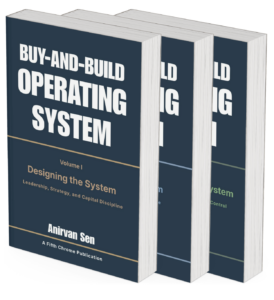
Then this book might be for you: Buy-and-Build Operating System, 3-volume set, available on all Amazon sites globally.
Visit Amazon in the US, UK, DE, FR, ES, IT, NL, JP, BR, CA, MX, AU, PL, SE, BE, IE, or IN to get your copy today.