Criticality of understanding the stages of scaling and growth
Lessons from advising buy-and-build platforms through every stage of growth
Anirvan Sen · October 2026
◆
Why do some companies keep scaling while others stall at a particular level of revenue? The instinct is to blame the CEO. Perhaps the founder has reached the limit of their capability. Perhaps the business needs professional managers, or someone from a larger company to come in and take it to the next level. In my work advising buy-and-build platforms, I have come to believe the problem is much bigger than any one person.
A company can have an excellent product, a strong founder, professional managers, access to capital, and a growing market, and still struggle to scale. When that happens, the underlying issue is often that leaders, founders, and investors are treating scaling as one continuous, homogeneous journey. It is not. The biggest scaling mistake is not simply failing to grow. It is trying to run the next-stage business using the capabilities and operating model of the previous stage.
A $10 Million Company Is Not a Smaller $100 Million Company.
A company does not simply become a larger version of itself. The organization’s nature changes as it grows. The way decisions are made is different. The founder’s role is different. Finance becomes more sophisticated, and so does HR’s purpose. Capital is used differently, the need for professional management differs, and systems matter in ways they didn’t before.
That is why I think the usual planning question is the wrong one. Leadership teams ask: how do we grow from $20 million to $100 million? The better question is: what must the organization become at each stage between $20 million and $100 million? The first question sets a destination. The second tells you what has to be built to reach it.
The Five Stages
In my framework, revenue provides a simple, easy-to-understand marker for the characteristics that tend to appear at different points on the journey. The ranges are stage markers, not rigid boundaries. A $29 million business does not suddenly become a different organization at $30 million. The ranges help identify the shifts a company often needs as it grows.
| Stage | Revenue | Name | What defines it |
| 1 | $5M–$15M | Founder-Led | Founder remains central to almost everything |
| 2 | $15M–$30M | Foundation Formation | Processes, systems, first professional managers |
| 3 | $30M–$60M | Capabilities Build | Capabilities, internationalization, acquisitions |
| 4 | $60M–$120M | Institutionalization | Runs on data, systems, professional management |
| 5 | $120M–$250M+ | Strategic Capital Leveraged Growth | Capital allocation becomes a growth engine |
In the Founder-Led stage, the founder makes decisions about hiring, compensation, customers, investments, and often relatively minor matters. That structure is not wrong. It often got the company here, and the business moves quickly because decision-making is concentrated. But the company can only scale as far as the founder’s capacity allows. The model that explains the growth eventually becomes the reason growth cannot continue in the same way.
Foundation Formation is where the company starts reducing its dependence on one person. Processes and systems begin to appear, and one or two professional managers join, so the company starts to scale through a small leadership system rather than through one person’s capacity. Capabilities Build then asks a different question: what do we need to become exceptionally good at doing? It might be technology, commercial excellence, product development, operations, or talent. Some spending shifts from cost control to investment in future capability, often before the return is visible. International markets, a broader product portfolio, and acquisitions start to enter the picture.
Institutionalization is one of the biggest shifts in the whole journey, and a simple test captures it: could the founder disappear for thirty days and the company continues operating properly? If not, the business may be large, but it has not truly institutionalized. The company increasingly runs on data, systems, management processes, and professional leaders. Gut instinct and entrepreneurial judgment still matter, but neither is enough to run the whole organization. In the final stage, Strategic Capital Leveraged Growth, capital becomes a growth engine in its own right. The question is no longer whether money is available. It is where each incremental unit of capital creates the most long-term value across new markets, capabilities, acquisitions, technology, and talent.
Why $20 Million to $100 Million Is Not One Jump
Across the stages, a company growing from $20 million to $100 million doesn’t cross one stage. It passes through Foundation Formation, Capabilities Build, and Institutionalization, and each transition creates new requirements that need deliberate intervention. Leadership should be thinking in stage transitions, not just revenue targets. Growth targets tell you where you want to go. Stage characteristics tell you what must change to get there.
Finance is a good illustration. A Finance leader at a $20 to $25 million company is rightly focused on controls, reporting, financial discipline, and visibility. Those things matter. But a company that wants to reach $50 to $60 million needs Finance to expand into investing in capabilities, longer-term value creation, and allocating capital between competing strategic priorities. Finance cannot simply become better at controlling today’s business. It has to help fund and shape tomorrow’s.
HR follows the same logic. In a Founder-Led business, HR is largely payroll, compensation and benefits, recruiting, and basic policies, with performance management and training handled informally. That can be sufficient for the stage. By Institutionalization, the business needs real performance management, learning and development tied to capability needs, succession planning, and leadership pipelines. The function moves from administering people toward building organizational capability.
Finance and HR are only two examples. Sales, marketing, operations, technology, and every other function evolves too. A company has several interconnected maturity curves, not one.
Buy-and-Build Compresses the Journey
Buy-and-build makes all of this harder, for two reasons. First, private capital shortens the clock. Growth targets are ambitious, horizons are defined, and reporting expectations rise. That compresses the time leaders have to learn the next stage through trial and error. A highly motivated leader who has never worked inside an $80 million organization hasn’t seen the destination, and when targets leave no time to learn it from scratch, the company needs people who have been there before, or mentors who have.
Second, acquisitions can increase revenue faster than the organization matures. A platform can move into a much larger revenue bracket while its leadership, systems, processes, talent, and management operating system still reflect an earlier stage. The result is a company with the revenue of an institution and the operating architecture of a founder-led business. That mismatch is dangerous because revenue looks like success.
For investors, the implication is practical. A revenue target without a stage-transition plan is little more than an aspiration. It matters to know which stage the company is actually in, which stage the investment thesis requires it to reach, which leaders can make that journey, and which capabilities need to be added.
Plan Backward From the Future State
The most useful shift I know is to design the next stage from the future state rather than from today’s organization. If a company is at $20 million and wants to reach $50 million, ask what a successful $50 million organization actually looks like. What leadership does it have? What capabilities and systems exist? How is Finance operating, and what is HR doing? What information is available, and how are decisions made? How dependent is the business on its founder? Then work backward from the answers.
Used this way, the stages become a roadmap. Where are we today, judged by organizational characteristics and not just revenue? Which stage are we trying to reach, and by when? What has to change between the two across strategy, leadership, talent, management systems, capital, technology, and culture? Where are the biggest gaps, and which capabilities must we build first?
Which Stage Are You In, and Which One Are You Building For?
Growth changes a company’s size. Scaling changes its nature. Too many leadership teams miss that distinction, so a company with every advantage can still stall: it keeps running the next stage with the last stage’s organization.
So the question worth asking is not only how fast the business can grow. It is which of these five stages you are actually in today, which one you are building for, and what the organization must become to get there. You do not scale a company by making the existing business bigger. You scale it by repeatedly rebuilding the organization for the requirements of its next stage.
◆ ◆ ◆
This article was inspired by the Podcast/YouTube on this topic: YouTube, Spotify, Apple Podcasts.
◆ ◆ ◆
ABOUT THE AUTHOR
Anirvan Sen is a business strategist, author, and CEO and Founder of Fifth Chrome — advising CEOs, PE investors, family offices, and Fortune 500 organizations on strategy, leadership, transformation, and M&A. He created the Buy-and-Build Operating System framework and has written multiple books on M&A, leadership, strategy, and organizational design.
Where This Conversation Can Go Next
The ideas discussed here are part of the work we do at Fifth Chrome through SCALEUP, Sales Enablement – TRAITS, and our Buy-and-Build Operating System—designed for leaders serious about building businesses that can scale, integrate, and compound.
If this resonates and you believe a deeper conversation would be valuable, you can reach us at buyandbuild@fifthchrome.com.
About Fifth Chrome
At Fifth Chrome, we help companies unlock unprecedented opportunities through M&A, buy-and-build, scaling up, and leadership strategies. Whether you’re a Fortune 500 company, a mid-cap, or an SME, our expertise in M&A integration, leadership development, and strategic advisory services can help you achieve scalable growth with precision and speed.
Contact Us
Visit us at fifthchrome.com for more information on our services or to schedule a consultation.
Ready to Go Deeper?
Want to dive deeper into the stages of growth, their corresponding structures, leadership styles, and operating models?
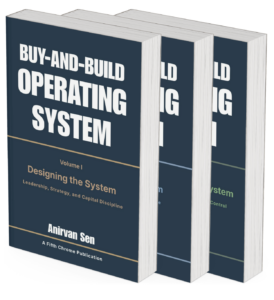
Then this book might be for you: Buy-and-Build Operating System, 3-volume set, available on all Amazon sites globally.
Visit Amazon in the US, UK, DE, FR, ES, IT, NL, JP, BR, CA, MX, AU, PL, SE, BE, IE, or IN to get your copy today.