A Buy-and-Build Perspective on Founder-Led Growth
Lessons from advising buy-and-build platforms through founder-led growth and scale
Anirvan Sen · September 2026
◆
Most founder-led businesses reach the same moment eventually. The thing that made the founder indispensable in the early years — the expertise, the relationships, the instinct for the right call — starts to slow the business down instead of driving it forward. That is not a character flaw, and it is not a sign the founder did anything wrong. It is close to a universal stage in scaling a business. What actually separates one founder from another is what happens next.
In my work advising buy-and-build platforms, I have watched this moment play out many times, and the founders who go on to build genuinely large organizations are rarely the ones who avoid this moment entirely. They are the ones who recognize it quickly, and respond to it with curiosity instead of defensiveness.
The Paradox Is a Stage, Not a Verdict
Early in a business, the founder is usually the answer to almost everything. They understand the customer better than anyone else. They solve the hardest problems personally. They win the first clients, make the product calls, and hire the first employees. That concentration of capability in one person is not a weakness in the early years — it is often exactly what gets a business off the ground.
The paradox is that the same qualities keep operating long after they stop being useful. The founder who was once the fastest path to a good decision becomes, at a larger scale, the slowest one — not because they have changed, but because the business around them has. Every scaling founder eventually meets this moment. It is not a verdict on any one of them. It is simply the point where the skills that built the business and the skills that will scale it stop being the same skills.
Two Responses to the Same Moment
What happens at that point is where founders genuinely diverge, and the difference has very little to do with talent.
One path looks like this: the founder notices decisions are taking longer, notices they are the common denominator in every escalation, and treats that as information rather than as a threat. They get curious about what they do not yet know. They seek out coaching, leadership programs, outside perspective, or simply more time with people who have scaled further than they have. They treat “I do not have the answer to this anymore” as a normal and useful thing to say out loud.
The other path looks very different. The founder notices the same symptoms — slower decisions, more escalations, more friction — but reads them as evidence that something is wrong with the people around them rather than with how their own role has to change. Hiring gets blamed. Execution gets blamed. Commitment gets blamed. The business keeps growing for a while, because growth and scale are not the same thing, but the strain keeps building underneath it.
Both founders hit the exact same moment. Only one of them is still building toward something larger a few years later.
Why Humility Is a Scaling Capability, Not a Soft Trait
It is tempting to file humility under personality — a nice quality to have, but not something that shows up on a balance sheet. I would argue the opposite. Humility is what allows a founder to accurately read what is actually possible for the business versus what is not, instead of getting blindsided by their own blind spots.
A founder without it tends to discover the gap between ambition and organizational reality at the worst possible moment — usually when a plan has already failed publicly. A founder with it tends to discover the same gap much earlier, quietly, through the ordinary discomfort of being told something they did not want to hear. Continuous learning — formal courses, coaching, outside boards, peer groups — is simply the practical expression of that humility. It is not an indulgence reserved for founders who have already made it. It is closer to maintenance.
The Blame Trap
The absence of humility rarely announces itself directly. It shows up as a pattern of explanation. Deals fall through because the sales team could not execute. A launch slips because operations was not ready. A senior hire does not work out because, in hindsight, they were never the right fit. Each explanation can sound entirely reasonable in isolation.
The pattern becomes visible only in aggregate: a founder for whom the organization is consistently the problem, and the founder’s own evolving role is never part of the explanation. That pattern is worth taking seriously, because it tends to be self-reinforcing. Blaming the organization relieves the immediate pressure to change anything about how the founder operates — which means the underlying constraint never actually gets addressed, and the same pattern of blame shows up again at the next stage of growth.
The Thirty-Day Test, as a Tool for Self-Awareness
There is a simple, honest way for a founder to check which path they are actually on: if I disappeared for thirty days, what would stop?
The value of that question is not the answer itself — most founders can guess roughly what the answer will be before they ask it. The value is in how willingly they ask it. A founder genuinely practicing humility runs this test on themselves periodically, treats the answer as useful information, and goes to work on whatever it reveals. A founder caught in the blame trap tends to avoid the question entirely, or answers it defensively, because the honest answer threatens a story they would rather keep telling about themselves.
Buy-and-Build Is Betting on This Trait, Not Just the Business
This matters enormously for buy-and-build platforms specifically, because every acquisition of a founder-led business is, whether anyone names it explicitly or not, also a bet on which of these two founders is sitting across the table.
A founder who recognizes their own limits and keeps investing in evolving past them tends to be a genuine asset through integration — someone who adapts to new reporting lines, new peers, and new ways of operating without treating all of it as a threat to their authority. A founder caught in the blame trap tends to become something closer to a retention and culture risk: someone who reads the friction of integration as evidence that the new parent company does not understand the business, rather than as the ordinary cost of scaling further than they could have gone alone.
That is worth assessing directly during diligence and integration planning, rather than assumed. Deal teams spend considerable effort evaluating a target’s financials, its customer concentration, and its market position. How a founder has responded to their own growing pains — whether they sought out help or found someone else to blame — deserves a comparable level of attention, because it says a great deal about how that founder will respond to everything integration is about to ask of them.
What Actually Predicts What Happens Next
Hitting the moment where you have become your own business’s bottleneck is not the interesting part of this story. Nearly every founder who scales anything meaningful gets there eventually. The interesting part — the part that actually predicts what happens next — is what they do the moment they notice.
The founders worth betting on are not the ones who never become the constraint. They are the ones who notice it first, say so out loud, and go to work on themselves with the same seriousness they once brought to building the thing in the first place. That is not a trait some founders simply have and others do not. It is a discipline, and like most disciplines, it can be built.
◆ ◆ ◆
This article was inspired by the Podcast/YouTube with Samit Sengupta: YouTube, Spotify, Apple Podcast
◆ ◆ ◆
ABOUT THE AUTHOR
Anirvan Sen is a business strategist, author, and CEO and Founder of Fifth Chrome — advising CEOs, PE investors, family offices, and Fortune 500 organizations on strategy, leadership, transformation, and M&A. He created the Buy-and-Build Operating System framework and has written multiple books on M&A, leadership, strategy, and organizational design.
Where This Conversation Can Go Next
The ideas discussed here are part of the work we do at Fifth Chrome through SCALEUP, Sales Enablement – TRAITS, and our Buy-and-Build Operating System—designed for leaders serious about building businesses that can scale, integrate, and compound.
If this resonates and you believe a deeper conversation would be valuable, you can reach us at buyandbuild@fifthchrome.com.
About Fifth Chrome
At Fifth Chrome, we help companies unlock unprecedented opportunities through M&A, buy-and-build, scaling up, and leadership strategies. Whether you’re a Fortune 500 company, a mid-cap, or an SME, our expertise in M&A integration, leadership development, and strategic advisory services can help you achieve scalable growth with precision and speed.
Contact Us
Visit us at fifthchrome.com for more information on our services or to schedule a consultation.
Ready to Go Deeper?
Want to dive deeper into the stages of growth, their corresponding structures, leadership styles, and operating models?
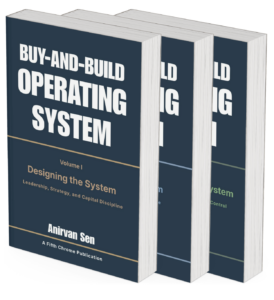
Then this book might be for you: Buy-and-Build Operating System, 3-volume set, available on all Amazon sites globally.
Visit Amazon in the US, UK, DE, FR, ES, IT, NL, JP, BR, CA, MX, AU, PL, SE, BE, IE, or IN to get your copy today.