What Exit Readiness Really Demands of a CFO
Anirvan Sen · September 2026
◆
Every buy-and-build platform is built with an ending in mind. Sponsors underwrite the roll-up, management assembles the acquisitions into something coherent, and somewhere on the horizon sits a transaction that will test everything the business has become. Most writing about that moment focuses on valuation, negotiations, and deal structure. Far less attention goes to what happens inside the company while all of that unfolds — and to the person who ends up carrying more of that weight than almost anyone else: the Chief Financial Officer.
In my work advising buy-and-build platforms through this stage, I have watched the same transformation happen again and again. A role built around finance, accounting, and reporting expands, almost overnight, into something considerably broader — and the CFO who was managing the numbers is suddenly managing the story investors are being asked to believe. For any buy-and-build platform working toward its own eventual exit, that transformation is worth understanding long before the process begins.
The Job Changes, Not Just the Workload
Under normal circumstances, a CFO’s territory is reasonably well defined: financial control, accounting, cash management, planning, forecasting, performance management, governance, financial reporting. It is a demanding role, but a bounded one.
An exit removes the boundary. The CFO increasingly becomes financial leader, transaction coordinator, information architect, adviser to the CEO, interface with investors, translator of operational performance, source of institutional knowledge, and guardian of the credibility of the financial story — often simultaneously. This is not simply more work stacked onto an existing job. It is a change in scope. The CFO becomes one of the few people in the organization who needs to see the entire business at once, through operational, financial, and investor lenses together.
That shift matters for buy-and-build platforms in particular, where the CFO has usually spent years focused on consolidating acquisitions, standardizing reporting, and keeping the group’s finances coherent across multiple entities. Exit asks something different of that same person: not just to consolidate the numbers, but to defend them.
Reporting Moves to a Different Level
One of the clearest changes I see once a transaction process begins is the sheer intensity of reporting. A headline revenue figure is no longer enough. Investors and advisers want to understand the business in far greater resolution — and the questions rarely stop at the first answer.
They move toward revenue by customer and by segment, the split between recurring and non-recurring revenue, customer concentration, margins by product or service line, working-capital movements, the reasoning behind historical variances, the assumptions underneath the forecast, cost movements, the sales pipeline, customer retention, operational KPIs, and the specific drivers behind any change in performance. Every answer tends to raise another question.
For a buy-and-build platform, this is where the discipline of prior integration work either pays off or gets exposed. An organization that can produce reliable, granular information quickly has usually already done the hard work of standardizing systems and reporting across its acquisitions. One that cannot is discovering, mid-transaction, that its finance function was never built to answer questions at this depth.
Everything Happens Faster
An exit also changes how fast the business runs. Questions that might normally take several days to investigate need answers far sooner. Information has to move faster, decision cycles shorten, and priorities can shift with little warning. Senior management can find itself operating at a level of urgency that does not exist in normal operations.
For the CFO, this demands more than analytical ability. It requires judgment, prioritization, responsiveness, a willingness to act on incomplete information, and the discipline to separate what is material from what is merely interesting. The difficulty is that speed cannot come at the cost of credibility — the standard the process sets is not “fast” or “right,” but both at once.
Understanding the Whole Business, Not Just the Accounts
During an exit, finance cannot operate as a function separate from the rest of the business. Investors are trying to understand the company’s future economic potential and risk, and financial statements are only the starting point of that conversation.
If margins fall, why? If a customer leaves, why? If revenue accelerates, what is actually driving it? If working capital moves, what operational behavior drives it? If management is forecasting growth, what capabilities make that growth credible? If performance varies between business units, what explains the difference? A CFO who can only speak to the accounts will struggle to answer these questions convincingly. A CFO who understands the business behind the accounts — the customers, the operations, the commercial logic — becomes considerably more valuable, and considerably harder to catch off guard.
The Bridge Between the Company and Its Investors
Perhaps the idea I come back to most often when advising these platforms is the position the CFO ends up occupying between two worlds. On one side sits the operating business: customers, people, processes, commercial decisions, operational problems, investments, opportunities, and management’s own assumptions about the future. On the other side sit investors trying to understand returns, risk, cash generation, resilience, growth, predictability, management capability, and future value.
The CFO connects those two worlds. The job is not simply to hand investors a set of numbers — it is to explain what those numbers mean. In that sense, the CFO becomes a translator: turning operational reality into financial consequence, management ambition into financial assumptions, historical performance into a forward-looking investment story, and investor concerns into questions management actually needs to answer. That bridging role is what makes credibility so central during a transaction. Investors aren’t just evaluating a business — they are evaluating whether the person explaining it can be trusted.
The Human Reality Behind the Technical Language
Transactions tend to be discussed in technical terms — valuation, due diligence, data rooms, negotiations, EBITDA, deal structure. What gets lost in that language is a human reality that rarely makes it into the deal narrative: the CFO is usually still running normal finance operations while simultaneously carrying the transaction on top of it.
That combination can mean extremely long days, repeated information requests, short deadlines, shifting questions, multiple stakeholders to manage, confidential discussions you can’t share with the wider team, intense scrutiny from management, and sustained cognitive pressure for months. The difficulty isn’t simply the volume of work. It is volume, urgency, and consequence arriving together — because mistakes matter, delays matter, and explanations matter, often in real time, in front of an audience with a direct financial stake in getting the answer right.
What Hindsight Actually Teaches
Across the platforms I have advised through this stage, one pattern stands out only in hindsight: most of the pressure of the exit process could have been avoided with preparation that happened long before the process began—information that should have been standardized earlier. These questions should have had ready answers, assumptions that should have been stress-tested before an investor ever asked about them.
That distinction is useful for any buy-and-build platform to sit with. The instinct is to treat exit readiness as something to build in the months before a transaction starts. What I have consistently seen suggests the opposite: by the time the process is underway, most of the preparation window has already closed. What remains is execution under pressure, informed by whatever discipline was — or was not — built into the business beforehand.
The Bigger Leadership Lesson
Although the pressure lands hardest on the CFO, its implications extend well beyond finance. An exit stress-tests the entire company’s management system, and it does so quickly.
It exposes how good the company’s data actually is, whether management truly understands its own performance, whether information can be produced at speed, whether forecasts are credible, whether operational KPIs connect meaningfully to financial results, whether senior leaders can explain why the business performs the way it does, whether important decisions are documented, and whether the organization depends too heavily on a small number of individuals to hold the whole picture together. These are not transaction questions. They are management-quality questions — and for a buy-and-build platform, they ask whether the integration work of the preceding years built a company capable of standing up to scrutiny, or simply a larger version of the same gaps.
Would Your Platform Survive Investor-Level Scrutiny Today?
That question is worth sitting with independent of any live transaction. If preparing for an exit would require months of frantic work to explain the business, that reveals something deeper than transaction-unreadiness. It may reveal that the platform is not yet management-ready.
A well-run buy-and-build platform should already understand much of what investors will eventually want to know: where profits actually come from, which customers matter most, what drives growth, what threatens margins, how predictable revenue really is, what capabilities the business will need to sustain its growth, and what risks management is currently carrying — knowingly or not. Exit readiness, seen this way, is not a checklist to complete before a transaction. It is a fair test of how well the platform has been built all along—and whether the CFO has already become the bridge the business will eventually need.
.
◆ ◆ ◆
ABOUT THE AUTHOR
Anirvan Sen is a business strategist, author, and CEO and Founder of Fifth Chrome — advising CEOs, PE investors, family offices, and Fortune 500 organizations on strategy, leadership, transformation, and M&A. He created the Buy-and-Build Operating System framework and has written multiple books on M&A, leadership, strategy, and organizational design.
Where This Conversation Can Go Next
The ideas discussed here are part of the work we do at Fifth Chrome through SCALEUP, Sales Enablement – TRAITS, and our Buy-and-Build Operating System—designed for leaders serious about building businesses that can scale, integrate, and compound.
If this resonates and you believe a deeper conversation would be valuable, you can reach us at buyandbuild@fifthchrome.com.
About Fifth Chrome
At Fifth Chrome, we help companies unlock unprecedented opportunities through M&A, buy-and-build, scaling up, and leadership strategies. Whether you’re a Fortune 500 company, a mid-cap, or an SME, our expertise in M&A integration, leadership development, and strategic advisory services can help you achieve scalable growth with precision and speed.
Contact Us
Visit us at fifthchrome.com for more information on our services or to schedule a consultation.
Ready to Go Deeper?
Want to dive deeper into the stages of growth, their corresponding structures, leadership styles, and operating models?
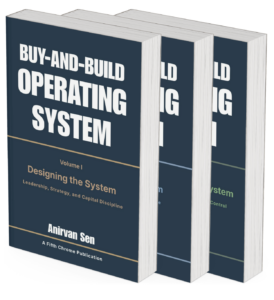
Then this book might be for you: Buy-and-Build Operating System, 3-volume set, available on all Amazon sites globally.
Visit Amazon in the US, UK, DE, FR, ES, IT, NL, JP, BR, CA, MX, AU, PL, SE, BE, IE, or IN to get your copy today.