How Minority Investors Shape Extraordinary Companies Without Running Them
Anirvan Sen · July 2026
Most founders believe that giving away 20% of their company means giving away 20% of the control. Ironically, the opposite is often true. The best venture capital and growth equity investors rarely control management. Instead, they build governance systems that prevent management from becoming uncontrollable — a subtle but critical distinction that separates disciplined value creation from slow-motion value destruction.
This raises the central question every founder eventually asks, usually too late: how do investors with only fifteen to thirty percent ownership manage to influence the trajectory of billion-dollar companies without ever becoming operators themselves? The answer lies not in ownership percentages, but in architecture — the invisible scaffolding of governance that shapes decisions long before a vote is ever called.
◆ ◆ ◆
The Great Misconception — Ownership vs. Governance
The confusion begins with a simple category error. Founders equate ownership with control, and control with authority over decisions. But majority ownership and operational control are not the same thing, and neither is day-to-day management the same as strategic governance. A board seat is not a manager’s chair. An investor holding twenty percent of the equity is not trying to become chief executive — nor should they want to.
The professional investor’s objective is narrower and, in a sense, more disciplined: protecting and compounding enterprise value. That objective does not require running the business. It requires ensuring the business is run well, consistently, and in a way that survives the departure of any single individual — including the founder.
Management creates value. Governance protects and directs value creation. Confusing the two is the single most common error boards make in the first eighteen months after an investment closes.
◆ ◆ ◆
The Governance Architecture Behind Minority Investing
Professional investors do not rely on ownership. They rely on architecture — a deliberately engineered set of mechanisms that translate a minority stake into meaningful, durable influence. This architecture typically rests on seven pillars:
- Board composition — the mix of independent, investor, and management directors that determines whose voice carries weight in the room.
- Reserved matters — the defined list of decisions that cannot be made without investor consent, regardless of board vote.
- Information rights — the contractual guarantee of timely, accurate visibility into the business.
- Budget approval — the annual discipline that forces strategy into numbers before the year begins.
- Capital allocation — the gating mechanism around how cash is deployed, reinvested, or returned.
- Executive appointments — influence over who sits in the seats that matter most.
- Risk oversight — the standing mechanism for surfacing problems before they become crises.
None of these pillars require a majority stake. Together, they create discipline without destroying entrepreneurial freedom — which is precisely the balance that separates governance from interference.
◆ ◆ ◆
Why Good Investors Don’t Micromanage
Micromanagement is tempting, especially for investors who once ran operating businesses themselves. It is also, almost without exception, value-destructive. It slows decision-making at the exact moment speed matters most. It erodes founder motivation, since few entrepreneurs stay energized once every decision is second-guessed. It suppresses innovation, because experimentation requires latitude that micromanagement forecloses. And it quietly dismantles accountability — when an investor makes the call, the operator no longer owns the outcome.
The distinction between a poor investor and a great one is not how much authority they hold, but how they choose to exercise it.
The poor investor controls decisions. The great investor controls decision-making processes.
That single sentence is worth sitting with. It reframes governance from an act of intervention into an act of design — building the conditions under which good decisions become the default, rather than making the decisions oneself.
◆ ◆ ◆
The Invisible Operating System
The most sophisticated investors do not think of governance as a series of meetings. They think of it as an operating system — a continuous rhythm that runs quietly underneath the business, largely invisible to anyone outside the boardroom, yet decisive in shaping outcomes. That system is built from eight recurring components:
- Strategic planning cadence. A fixed annual and quarterly rhythm for revisiting and refining the company’s strategic direction, rather than leaving strategy to an occasional off-site.
- KPI architecture. A defined, hierarchical set of metrics — leading and lagging — that surfaces the signals that matter before they harden into problems.
- Leadership cadence. A recurring rhythm of conversations about the leadership bench: who is ready, who is at risk, and who needs support.
- Capital allocation discipline. A consistent, criteria-driven process for deciding where cash is invested, reinvested, or returned.
- Board rhythm. A predictable sequence of board meetings and materials, so governance runs on a schedule rather than in response to events.
- Risk reviews. Standing sessions dedicated to surfacing operational, financial, and market risks before they escalate.
- Talent reviews. Periodic, structured assessment of the organization’s people capability against the business’s direction.
- Performance conversations. Regular, candid dialogue between the board and management on results against plan — not reserved for when results disappoint.
Listing these components, however, is the easy part. Most boards can name them. Few boards actually run them as a system — and the difference between a board that lists these elements and one that operates them is what separates governance in name from governance in practice. An operating system only functions if it is run on four disciplines.
- Fixed cadence. Strategic reviews, capital allocation discussions, and talent conversations must sit on the calendar months in advance, independent of whether the business is having a good quarter or a difficult one. The moment a cadence becomes reactive — triggered by bad news rather than scheduled in advance — the operating system has already failed, because its entire value lies in catching problems before they become visible enough to force a meeting.
- Named ownership. Every recurring element of the system needs a single accountable owner — not a committee, not “the board collectively,” but one name attached to one outcome. A KPI architecture with no named owner degrades within two quarters into a reporting exercise nobody reads closely.
- Automatic escalation. Information rights are worthless if bad news only surfaces when an investor happens to ask the right question. The system must be designed so that deteriorating metrics, missed milestones, or emerging risk trip a predefined escalation path on their own — moving upward through management, then the board, without waiting for anyone to notice.
- Closed feedback loop. Decisions made in one cycle must reappear as tracked inputs in the next. A capital allocation decision made in March means little if no one checks in September whether it produced the return it promised. Without this loop, an operating system produces the appearance of discipline without ever generating the learning that discipline is supposed to create.
None of these four disciplines, on their own, looks dramatic. Their power lies in repetition. A single strong board meeting changes little; a governance operating system, run on a fixed cadence, with named ownership, automatic escalation, and closed feedback loops for three consecutive years changes everything.
◆ ◆ ◆
Preventing the Runaway CEO
This is the question every investor eventually faces in private: what happens when a founder or CEO begins to outgrow the governance structure meant to contain them? The answer, in well-governed companies, is rarely dramatic. Good governance solves problems long before leadership replacement becomes necessary, through a sequence of progressively firmer interventions.
The Progressive Intervention Ladder
- Stage 1: Coaching — private, direct feedback aimed at correcting course without escalation.
- Stage 2: Increased transparency — tighter reporting and information rights to restore visibility.
- Stage 3: Independent directors — adding outside judgment to rebalance the board.
- Stage 4: Strengthened executive team — building capability around the CEO to reduce single-point dependency.
- Stage 5: Governance intervention — formal use of reserved matters and board authority.
- Stage 6: CEO replacement — the last resort, used only when every prior stage has failed.
In a well-governed company, Stage 6 is rare precisely because Stages 1 through 5 were designed to make it unnecessary.
◆ ◆ ◆
The Difference Between VC, Growth Equity, and Buyout PE
Governance intensity is not uniform across the private capital landscape. It scales with certainty, and it scales with the maturity of the business being governed.
| Dimension | Venture Capital | Growth Equity | Buyout PE |
| Core focus | Founder enablement | Scale discipline | Value acceleration |
| Orientation | Experimentation | Repeatability | Operational transformation |
| Governance posture | Governance light | Governance balanced | Governance intensive |
| Certainty level | High uncertainty | Moderate uncertainty | Low uncertainty |
| Investor role | Coach founders | Build executives | Drive performance |
The pattern is instructive. As uncertainty falls and ownership rises, governance does not become optional — it becomes more structured, more intensive, and more central to how value is created. Buyout PE does not use heavier governance because it wants more control for its own sake. It uses heavier governance because the stakes, and the certainty of the underlying thesis, demand it.
◆ ◆ ◆
The Next Evolution — Governance as Value Creation
Governance is too often described defensively, as something that exists to protect the investment. That framing understates what modern governance actually does. In the best-governed companies, governance does not merely guard against downside — it actively manufactures upside, through better decisions, faster decisions, sharper capital allocation, stronger leadership, deeper organizational capability, more disciplined innovation, and greater resilience under stress.
Governance is not a compliance function. Governance is an enterprise capability — as real and as valuable as any product, brand, or technology the company owns.
Investors who understand this stop asking “how do we protect our stake?” and start asking “how do we build a decision-making system this company will still rely on after we exit?” That shift in framing is, in itself, a competitive advantage.
◆ ◆ ◆
The companies that create extraordinary value are rarely those with the smartest founders or the largest investors.
They are the companies where governance quietly ensures that great decisions happen consistently — long after individual brilliance fades.
Where This Conversation Can Go Next
The ideas discussed here are part of the work we do at Fifth Chrome through SCALEUP and our Buy-and-Build Operating System — designed for leaders who are serious about building businesses that can scale, integrate, and compound.
If this resonates and you believe a deeper conversation would be valuable, you can reach us at scaleup@fifthchrome.com or buyandbuild@fifthchrome.com.
About Fifth Chrome
At Fifth Chrome, we specialize in helping companies unlock unprecedented opportunities through M&A, buy-and-build, scaling up, and leadership strategies. Whether you’re a Fortune 500 company, a mid-cap, or an SME, our expertise in M&A integration, leadership development, and strategic advisory services can help you achieve scalable growth with precision and speed.
Contact Us
Visit us at fifthchrome.com for more information on our services or to schedule a consultation.
Ready to Go Deeper?
Do you want to dive deeper into the stages of growth, their corresponding structures, leadership styles, and operational models?
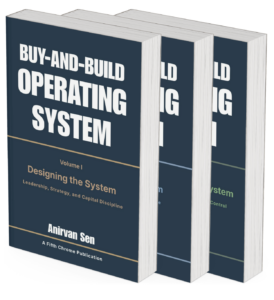
Then this book might be for you: Buy-and-Build Operating System, 3-volume set, available on all Amazon sites globally.
Visit Amazon in the US, UK, DE, FR, ES, IT, NL, JP, BR, CA, MX, AU, PL, SE, BE, IE, or IN to get your copy today.