The myth of self-powered growth and scaling
Lessons from advising Small-and-Medium Businesses through their scaling journey
Anirvan Sen · October 2026
◆
Ask the owner of an $8 million business what it will take to reach $15 million, and you will hear about customers, products, and hard work. You will rarely hear about cost. Behind the ambition sits an unspoken belief that growth will pay for itself: more sales will produce more profit, and more profit will fund the next step.
In my experience, it does not work that way. Growth does not fund itself, and it does not organize itself either. Somewhere between the first signs of momentum and a business that can run without its founder lies a bill most owners have never seen.
This article is about that bill. I use an illustrative company with $8 million in revenue, but the pattern holds across owner-led businesses below $10 million, where a founder or a small group of partners still sits at the center of selling, deciding, and solving problems. Revenue is a practical way to group these companies because they share so many characteristics. Every figure here is indicative. The purpose is awareness, not precision.
Three things owners get wrong: amount, type, and period
When owners underestimate scaling, they usually err in three ways at once. The first is amount: the total is larger than they assume. The second is type: they count visible, one-off items such as consultants, software, and a recruitment fee, and overlook commitments that never go away. The third is period: they expect returns within months, when the realistic horizon is 18 to 24 months.
Each of these errors is understandable on its own. Together, they explain why so many promising businesses start scaling with enthusiasm and stall halfway through, short on cash and patience.
The timeline in three phases
The easiest way to see the period problem is to follow the money across the 18 to 24 months. The investment moves through three phases, and most owners lose their nerve in the middle one.
| Phase | Months | What is happening | Where the money goes | What the owner sees |
| Build | 0–6 | New systems, processes and leaders are put in place | Most of the one-off investment; first payroll commitments begin | Spending is high and little has visibly changed |
| Absorb | 6–12 | New people and systems are in place but not yet productive | Full running cost; one-off spend tapers off | The cash and morale low point, and the phase where owners are most tempted to stop |
| Payoff | 12–24 | Sales, capacity and margins start to benefit | Running cost continues | Results arrive, later than most owners expected |
Illustrative phasing for an owner-led business. Actual timing varies with sector and starting point.
Costs lead, and benefits lag. An owner who understands this in advance treats the Absorb phase as expected. An owner who does not treats it as evidence that the plan has failed.
Cost type 1: the one-off build costs
These are the costs owners expect, and they are front-loaded into the Build phase. They include strategy and process work, systems and technology, leadership recruitment and development, and the commercial build-out: sales process, enablement, marketing programs and pricing work. A sensible contingency belongs here as well, because implementation almost always runs over.
For an $8 million business, I would use a planning allowance of 5 to 8 percent of annual revenue, or roughly $400,000 to $640,000. This is a planning heuristic, not a researched benchmark. A business with no CRM, no second-line leaders, and customer relationships held entirely by the founder will sit at the top of the range or beyond it.
Cost type 2: the permanent payroll step-up
This is the most underestimated item, and it is where the real money goes. A leadership layer is not a project cost. It is a recurring commitment that begins on the day of the hire and continues whether or not results have arrived.
Consider a three-person layer covering sales, operations, and finance. Fully loaded, that can run roughly $450,000 to $600,000 a year. In human terms, it is the equivalent of three senior hires for two years, or about $900,000 to $1.2 million over the period. Add the recurring costs that travel with a larger business, such as software subscriptions, incremental marketing and supporting roles, and the running cost over 18 to 24 months, and it lands at roughly $1.2 million to $1.5 million.
Founders anchor on the one-off items because those arrive as invoices with an end date. Payroll does not have an end date, and it is the number that surprises owners most.
Cost type 3: the hidden costs
Some costs never appear on an invoice, so owners rarely plan for them. The owner’s own time is the largest. Leading a transformation while running the business stretches the founder, and attention taken from customers has a price. Productivity dips while people learn new systems and roles. Margins come under pressure when capacity outpaces revenue.
Then there is the failed senior hire. A leader who doesn’t work out can cost six to twelve months of pay, plus the recruitment fee to replace them and the months the seat sits empty. These costs concentrate in the Absorb phase and show up less as a line item than as a slower payoff.
Combining the two priced categories gives owners an indication of the full commitment, in dollars and as a share of one year’s revenue.
| Dollars (illustrative $8M business) | Share of one year’s revenue | |
| One-off investment | $400K–$640K | 5–8% |
| Running cost over 18–24 months | $1.2M–$1.5M | Roughly 15–19% |
| Total commitment | About $1.6M–$2.1M | Roughly 20–27% |
Indicative planning figures, not validated benchmarks. Gross of the additional margin that new revenue will generate.
The word gross matters. These totals are before the margin that new revenue brings in, which is the whole point of the exercise. They show what must be funded, not what scaling will ultimately earn.
What sits outside the number
Three items are deliberately excluded and should be decided separately. Working capital, meaning the extra inventory, receivables, and cash that higher volumes tie up, is its own conversation. So are major capital expansion, such as a new facility, and acquisitions. Keeping them apart prevents two different decisions from blurring into one vague budget.
The gap between spending and payoff
The total matters less than the shape of the cash curve. Money leaves early and returns late, so cumulative cash falls before it recovers. The question that decides whether the plan survives is not only how much it costs, but how deep the dip goes and how long the business can sustain it.
This is where funding enters. Owners should decide before they start whether the commitment will come from operating cash flow, bank debt, or partner capital. A business that plans to fund a commitment of 20 to 27 percent of annual revenue entirely from current cash flow, with no margin for delay, is taking a larger risk than it realizes.
Six questions to answer before you scale
A short set of questions can turn a vague intention into a plan. They are worth answering in writing, ideally with a partner or adviser who will challenge the answers.
- What must be true of the business at the end of this period?
- Which costs are one-off, and which are permanent?
- Who owns each investment, and what evidence releases the next tranche of spending?
- How long can we fund the trough?
- What is our own time commitment, and what will we stop doing to make room for it?
- What are we deliberately leaving out?
If you can’t answer these clearly, the business isn’t ready to commit the money, and finding that out on paper is far cheaper than finding it out in month nine.
Closing: plan the bill before you grow
Scaling rewards owners who treat it as a planned investment with a cost, a type, and a duration, and it punishes those who assume it will follow growth on its own. The numbers in this article are indicative, but the logic is not: the commitment is larger than most expect, a good part of it is permanent, and the payoff arrives later than hoped.
This thinking is the starting point for the SCALEUP playbook, which uses a scaling investment estimator to help owners identify the specific investments needed in each category, with one-off cost, recurring cost, timing, and expected benefit for each.
What did scaling actually cost you, and where were you surprised? I would welcome your experience in the comments.
◆ ◆ ◆
ABOUT THE AUTHOR
Anirvan Sen is a business strategist, author, and CEO and Founder of Fifth Chrome — advising CEOs, PE investors, family offices, and Fortune 500 organizations on strategy, leadership, transformation, and M&A. He created the Buy-and-Build Operating System framework and has written multiple books on M&A, leadership, strategy, and organizational design.
Where This Conversation Can Go Next
The ideas discussed here are part of the work we do at Fifth Chrome through SCALEUP, Sales Enablement – TRAITS, and our Buy-and-Build Operating System—designed for leaders serious about building businesses that can scale, integrate, and compound.
If this resonates and you believe a deeper conversation would be valuable, you can reach us at buyandbuild@fifthchrome.com.
About Fifth Chrome
At Fifth Chrome, we help companies unlock unprecedented opportunities through M&A, buy-and-build, scaling up, and leadership strategies. Whether you’re a Fortune 500 company, a mid-cap, or an SME, our expertise in M&A integration, leadership development, and strategic advisory services can help you achieve scalable growth with precision and speed.
Contact Us
Visit us at fifthchrome.com for more information on our services or to schedule a consultation.
Ready to Go Deeper?
Want to dive deeper into the stages of growth, their corresponding structures, leadership styles, and operating models?
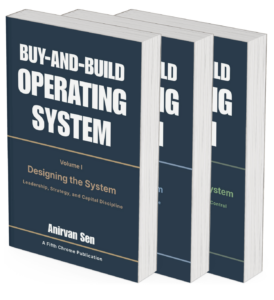
Then this book might be for you: Buy-and-Build Operating System, 3-volume set, available on all Amazon sites globally.
Visit Amazon in the US, UK, DE, FR, ES, IT, NL, JP, BR, CA, MX, AU, PL, SE, BE, IE, or IN to get your copy today.