Scaling from 7-figures to 8-figures needs change in thinking and approach
Anirvan Sen · November 2026
◆
One of the hardest transitions a small or medium-sized business can make is the move from roughly $5 million in revenue to $15 million. The reason isn’t simply that the company has to get bigger. It has to operate differently.
Most businesses reach their first few million dollars on the strength of the founder. Relationships bring in customers. Personal effort fills the gaps. Decisions are made quickly and informally, and a handful of key people hold the business together. That model works, sometimes remarkably well, until it doesn’t.
At some point, doing more of the same stops producing more. More hours don’t solve the problem. More effort doesn’t solve it, and neither does more money. The business itself has to change. In a recent episode of Buy-and-Build & Scaling Insights, I outlined the five operating disciplines that become increasingly important as an SME moves toward becoming a mid-market company. This article expands on them.
1. Turn Customer Creation Into a Process
Smaller businesses typically grow through the founder’s network. Customers arrive through referrals, reputation, introductions, or opportunities that emerge organically. In the early stages, this is a real strength.
The weakness is predictability. A company that wants to scale has to answer a more fundamental question: how does this business create customers, repeatedly? The answer has to become visible, repeatable, teachable, and measurable, and it has to depend less on any one individual.
The shift is subtle but important. “The founder knows how to bring in business” has to become “we understand how this company creates customers.” Customer creation stops being an individual talent and becomes an organizational capability.
2. Build a Sales Operating System
Once customer creation becomes more systematic, the business needs infrastructure to support it. I am not talking about a multimillion-dollar enterprise technology platform. At this stage, the fundamentals matter far more than the tools.
A basic sales operating system includes sales scripts, a prospect database, demos, marketing collateral, webpages, follow-up mechanisms, data capture, and a disciplined approach to ongoing engagement. The reason it matters is simple. As the company grows, commercial opportunities can no longer live in people’s memories. Leadership needs to know who is being pursued, where each prospect sits in the process, when the company last spoke with them, what happens next, who owns the follow-up, and which opportunities are getting stuck.
Without that discipline, potential revenue quietly leaks away.
It is worth being clear that these first two disciplines are related but different. Customer creation defines how the company generates and converts demand. The sales operating system provides the infrastructure and discipline to run that process repeatedly. A company can understand how it creates customers and still fail because nobody follows up consistently. Equally, it can have a CRM full of names and no clear process behind them. Neither scales well. You need both.
3. Develop Financial Acumen
The third discipline is financial acumen, and it is where I have seen many otherwise strong businesses struggle. They understand their customers, products, engineering, services, and operations. They do not understand their financial engine deeply enough. As the business grows, that gap becomes dangerous.
A scaling CEO needs to understand how revenue is generated, what costs are incurred, what fulfillment actually costs, and where margins sit. They also need to understand working capital, receivables, payables, investment requirements, and the company’s financial cycle. That does not mean the CEO has to become the CFO. It means the CEO must understand the financial consequences of growth.
Here is the paradox of scaling: a business can grow its revenue while weakening its cash position. Sales increase quickly, but customers take longer to pay. The company hires additional people. Inventory or fulfillment requirements rise. Suppliers need to be paid before customers pay you. On paper, revenue is growing. Operationally, cash is disappearing.
This is why scaling requires more than watching the top line. The CEO has to understand how growth converts into margin, then working capital, and ultimately cash.
4. Become Deliberate About Capital Allocation
Once you understand the financial engine, a new question appears: what should we do with the money the business generates?
For an SME, this question matters more because capital is limited. Owners naturally take money out of the company. That is part of the reason for owning a business. But if too much operating margin is distributed, the company can suddenly find itself short of cash when it faces taxes, broken equipment, technology requirements, unexpected expenses, or a genuine growth opportunity.
More importantly, scaling itself requires investment. It may call for new capabilities, software, additional salespeople, more employees, or better infrastructure. So the real question becomes: how much of today’s profit should we consume, and how much should we reinvest in tomorrow’s company? That is capital allocation.
It is also not simply a matter of having money. Even businesses with cash can allocate it badly. Which capabilities should we build? Where should we invest first? What should we delay? Which investments will genuinely enable growth, and which will simply make the organization more expensive? Capital allocation connects today’s economics with tomorrow’s capability, which is why it becomes one of the CEO’s most important scaling disciplines.
5. Establish a Disciplined Operating Cadence
The fifth discipline may be the most important of all: operating cadence.
I have seen companies with great products, brilliant founders, outstanding engineers, and strong customer propositions still struggle to scale. The problem is usually execution. They know what they should do. They don’t do it consistently. An operating cadence connects strategy with execution.
Many companies respond to this by saying, “We already have weekly meetings.” Weekly meetings are not an operating cadence. A real cadence requires metrics, actions, owners, timelines, accountability, follow-up, and consequences. Every important action has to answer a handful of questions. What needs to be done? Who owns it? By when? What happened since the previous meeting? What happens if it doesn’t get done?
That is very different from sitting around a table every Monday morning.
The Five Disciplines Work as a System
These disciplines are not independent. They form a chain, and each one depends on the others.
Customer creation produces repeatable demand. The sales operating system manages and converts that demand. Financial acumen shows whether the resulting growth is economically healthy. Capital allocation determines where the business invests to build its next capabilities. Operating cadence provides the execution discipline that keeps all four working.
Together, they move a company from founder-driven execution toward system-driven execution.
Why This Transition Is So Difficult
The difficulty is not that these concepts are complicated. Most founders already understand the logic. The difficulty is behavioral.
Scaling asks founders to document what used to be informal and to measure what used to be intuitive. It asks them to delegate what they once controlled, and to reinvest money they might otherwise distribute. It asks them to introduce accountability and then follow management disciplines consistently, even when it is uncomfortable. For many founders, that means stepping outside the very habits that built the business.
But that is often exactly what the next stage requires.
Scaling Does Not Mean Working Harder
This may be the most important point of all. Many entrepreneurs avoid scaling because they assume, “If I double or triple the business, I’ll have to work two or three times harder.”
That should never be the objective. If scaling increases the founder’s workload, the business has not really scaled. The goal is to build an organization that can carry more of the load, and that takes processes, systems, financial discipline, investment, and operating rigor.
The shift is not from working less to working harder. It is from working harder to operating better.
Five Questions to Ask Yourself
If you are running a business at around $5 million and want to reach $15 million, start with these questions:
- Do we have a repeatable process for creating customers?
- Do we have a basic sales operating system that ensures opportunities are followed through?
- Do we genuinely understand our financial engine?
- Are we deliberately allocating capital toward the capabilities our next stage requires?
- Do we have an operating cadence that converts decisions into accountable execution?
If several of your answers are no, adding more growth may add more complexity.
The Bigger Lesson
The company that reached $5 million cannot simply be stretched into a $15 million company. Somewhere along the journey, the way the organization operates has to change. Individual effort has to give way to organizational capability, and relationships to repeatable customer creation. Memory has to give way to systems, and revenue has to give way to financial discipline. Spending has to become capital allocation, and meetings have to become an accountable operating cadence.
You do not scale from $5 million to $15 million by doing more of the same. You scale by building a business that operates differently.
◆ ◆ ◆
Listen to the full episode of Buy-and-Build & Scaling Insights, hosted by Fifth Chrome and presented by Anirvan Sen. YouTube, Spotify, Apple Podcast
◆ ◆ ◆
ABOUT THE AUTHOR
Anirvan Sen is a business strategist, author, and CEO and Founder of Fifth Chrome — advising CEOs, PE investors, family offices, and Fortune 500 organizations on strategy, leadership, transformation, and M&A. He created the Buy-and-Build Operating System framework and has written multiple books on M&A, leadership, strategy, and organizational design.
Where This Conversation Can Go Next
The ideas discussed here are part of the work we do at Fifth Chrome through SCALEUP, Sales Enablement – TRAITS, and our Buy-and-Build Operating System—designed for leaders serious about building businesses that can scale, integrate, and compound.
If this resonates and you believe a deeper conversation would be valuable, you can reach us at SCALEUP@fifthchrome.com.
About Fifth Chrome
At Fifth Chrome, we help companies unlock unprecedented opportunities through M&A, buy-and-build, scaling up, and leadership strategies. Whether you’re a Fortune 500 company, a mid-cap, or an SME, our expertise in M&A integration, leadership development, and strategic advisory services can help you achieve scalable growth with precision and speed.
Contact Us
Visit us at fifthchrome.com for more information on our services or to schedule a consultation.
Ready to Go Deeper?
Want to dive deeper into the stages of growth, their corresponding structures, leadership styles, and operating models?
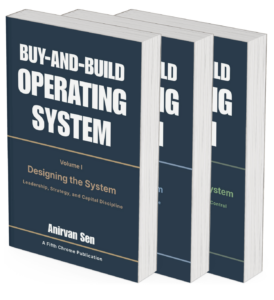
Then this book might be for you: Buy-and-Build Operating System, 3-volume set, available on all Amazon sites globally.
Visit Amazon in the US, UK, DE, FR, ES, IT, NL, JP, BR, CA, MX, AU, PL, SE, BE, IE, or IN to get your copy today.