The Seat That Cannot Be Left Empty
Why a Strategic HR Leader Is Non-Negotiable Across Every Stage of the Buy-and-Build Journey
THE OVERSIGHT NOBODY TALKS ABOUT
Ask any PE investor or mid-market CEO what their top three risks in a buy-and-build journey are, and you will hear variations of the same answers: deal flow discipline, integration execution, and capital allocation. These are real risks. They are also well-documented, heavily advised, and actively managed.
What rarely makes the list — and what quietly determines whether the other three succeed — is the absence of a strategic HR leader.
Not a head of HR in the traditional sense. Not a compliance officer dressed up in talent language. The role being described here is something more consequential: a leader who sits close enough to the CEO and the ELT to see the organization’s people and leadership reality clearly, who has the standing to challenge it, the skill to redesign it, and the judgment to know when the system is about to break before it does.
The people system is not a support function running alongside the business. It is part of the architecture itself.
In the Buy-and-Build Operating System — a three-volume framework for building, scaling, and institutionalizing multi-acquisition growth businesses — the five stages of buy-and-build are described as distinct structural environments, each imposing different demands on leadership, governance, and capital. What that framework makes clear, stage by stage, is that the people system is not a support function running alongside the business. It is part of the architecture itself. And without a strategic HR leader shaping that architecture, the organization builds on assumptions it has never examined and accumulates people-design debt that eventually constrains growth in ways that feel inexplicable but are entirely predictable.
This article makes a single, direct argument: the strategic HR role is non-negotiable across all five stages of the buy-and-build journey. The form it takes must be stage-appropriate — and there are real reasons not to overstaff this capability too early. But the capability must never be absent. The cost of its absence is not visible in the quarter it is deferred. It becomes visible two stages later, when the organization is moving too fast to fix what was never built correctly.
WHAT THIS ROLE ACTUALLY IS
Before the argument can be made, the role must be defined precisely, because the phrase ‘HR leader’ carries too much baggage. In most mid-market businesses, HR is associated with hiring coordination, employment contract administration, performance review administration, and ensuring compliance. These are necessary functions. They are not in this role.
The strategic HR leader — whether the title is CHRO, Chief People Officer, or HR Business Partner operating at the ELT level — has four distinct and permanent mandates that sit entirely above the operational HR function.
Architect of the evolving leadership structure
As the business acquires companies, adds entities, and grows its management layer, the organizational design either evolves deliberately or drifts accidentally. The strategic HR leader designs the leadership architecture in advance of where the business is going, not in response to where it already is. This means defining what the ELT needs to look like at the next stage, what roles must be created or separated, and how authority and accountability are distributed as complexity grows.
Challenger on the right people in the right seats
This is the most uncomfortable part of the role and, consequently, the part most often avoided. Buy-and-build businesses frequently carry leaders who were essential at one stage and become constraints at the next. The founder who built a $10 million business with instinct and personal authority is often not the same profile as the one needed to run a $60 million platform with five acquired entities. The strategic HR leader must have the standing and the courage to name these mismatches — not to be disruptive, but because ignoring them is what destroys value. No one else in the room is positioned to do this without a conflict of interest.
Trusted advisor to the CEO on people and leadership risk
The CEO of a buy-and-build business carries an unusual cognitive load. They are simultaneously managing the existing business, evaluating and executing acquisitions, managing investor relationships, and building a leadership team capable of handling the next level of complexity. In that environment, the CEO’s view of the organization’s people reality is almost always incomplete — not because they are inattentive, but because the information does not reach them cleanly. The strategic HR leader is the one person whose job it is to give the CEO an honest, un-politicized read on the leadership landscape: who is performing, who is struggling, where the dependencies are dangerous, and where the culture is drifting from what was intended.
Early-warning system for talent fragility and succession gaps
In buy-and-build environments, leadership risk is not random. It concentrates in predictable places: key individuals who hold institutional knowledge that has never been systematized, integration leaders who are absorbing far more than is sustainable, functional heads whose capabilities have not scaled with the role, and acquired business leaders whose continued engagement has been assumed rather than secured. The strategic HR leader maps these vulnerabilities continuously and surfaces them before they become crises.
These four mandates are not sequential or stage-specific. They apply at every stage of the journey. What changes is the intensity, the sophistication, and the organizational form through which they are delivered.
THE STAGE-BY-STAGE REALITY
Stages 1 and 2: The Part-Time Imperative
At Stage 1 — the Founder-Led Base, typically a business operating between $5 million and $15 million — the argument for a full-time strategic CHRO does not hold. The organization is compact. Formal structures are limited by design. Introducing a high-cost, institutionally-oriented HR leader into an environment that runs on proximity, instinct, and founder authority would not only be expensive — it would actively slow the business down. This is a real and legitimate concern, and dismissing it produces advice that no serious operator would follow.
But the absence of a full-time strategic HR leader does not mean the strategic HR capability can be absent. In the early stages, this capability can and should be delivered through a part-time strategic HR advisor — typically sourced through the investor or PE firm, or engaged externally on a retainer basis — working alongside an internal person responsible for implementation and day-to-day people operations.
The investor-assigned advisor model is particularly powerful. Many PE firms have operating partners who can provide the strategic counsel the business needs without the overhead of a full-time hire.
What matters is that someone is asking the strategic questions: What kind of culture are we building before it sets accidentally? What leadership profiles does this business need to acquire in the next eighteen months? Which of our current leaders will scale and which will not? Is the founder reducing dependency on themselves, or deepening it?
These questions rarely get asked at Stage 1 and Stage 2 because the business is focused on operating and growing. They are precisely the questions that prevent the most expensive problems in Stages 3 and 4.
Stage 3: The Inflection Point
Stage 3 — Multi-Acquisition Growth, at approximately $30 million to $60 millio, is where the absence of a dedicated strategic HR leader becomes a structural liability rather than a manageable gap.
At this stage, the organization is executing multiple acquisitions, absorbing diverse cultures, building an ELT that spans entities, and asking its leaders to operate at a level of complexity most have not encountered before. Leadership bandwidth is the binding constraint. Ambiguity is expensive. And the talent decisions made — or deferred — in this stage directly determine whether the business reaches Stage 4 as a coherent platform or as a collection of loosely connected entities held together by a small number of exhausted individuals.
The part-time advisor model is no longer sufficient. The organization needs a dedicated internal CHRO or Chief People Officer who is on the ELT, close to the integration workstreams, and actively managing the people architecture of the combined business. This is also the stage where cultural divergence between acquired entities becomes actively dangerous — and without a strategic HR leader actively managing cultural integration, the combined organization fragments in ways that are visible to customers and investors long before they are acknowledged internally.
Stages 4 and 5: Governance Actor and Institutional Architect
At Stage 4 — Institutionalization, typically $60 million to $120 million — the CHRO becomes a governance actor. This is the stage where every earlier compromise in people design is exposed by scale. The CHRO at this stage owns the succession architecture as a board-level accountability, designs and governs the incentive and reward structures across multiple entities, and is responsible for ensuring that culture now functions as an operating system that does not depend on any single individual to sustain it.
At Stage 5 — the Scaled Group and Institutional Capital stage, at $120 million and above — the institution is judged externally by its structure rather than its story. The CHRO’s work extends to board-level reporting on human capital, long-term incentive plan design across the portfolio, employer reputation as a strategic asset, and succession resilience at the CEO and C-suite level. The CHRO at Stage 5 is, in every substantive sense, a capital allocator for human capital.
WHY THIS ROLE IS CONSISTENTLY UNDERDEVELOPED
The evidence for underinvestment in strategic HR leadership in mid-market buy-and-build businesses is not hard to find. It is visible in the pattern of failures: integration stalls caused by cultural incompatibility that no one named in due diligence; ELT dysfunction that the CEO could see but had no trusted counsel to help navigate; leadership transitions that destroyed value because succession had been assumed rather than engineered; high-performing acquisitions that deteriorated because the talent of the acquired business was not secured.
The reasons for underinvestment are understandable, even if they are not defensible. The first is a category problem: HR is still primarily understood as a cost center in most mid-market businesses. The idea that the most senior HR leader should be a strategic peer to the CFO and COO runs counter to the mental model most founders and operators hold. The second is a sequencing problem: the instinct is to hire the strategic CHRO once the business has reached a certain size or complexity — but by then, the design debt has already accumulated. The third is a quality problem: finding the right person is genuinely difficult. But the difficulty of finding the right person is not an argument for leaving the seat empty. It is an argument for investing in the search.
THE RIGHT-PEOPLE-RIGHT-SEATS IMPERATIVE
There is a phrase that circulates in buy-and-build and scaling businesses: right people, right seats. It is repeated often enough to have become a cliché. But the cliché survives because it describes something real and consequential.
In a buy-and-build business, the leadership team is constantly evolving. Acquisitions bring new leaders. Growth creates roles that did not previously exist. Scale makes some existing leaders stretch and reveals that others have reached their ceiling. The strategic HR leader is the one person in the organization whose entire mandate is to see this clearly and to act on what they see — with diagnosis rather than bluntness, with precision rather than disruption.
When this role is absent, the right-people-right-seats principle remains a phrase rather than a practice.
Leaders stay in roles they have outgrown because no one with the standing to say otherwise is in the room. Acquisitions are integrated around the people who were there on day one rather than the people the combined business actually needs. The ELT calcifies around relationships and history rather than evolving around capability and stage-appropriateness. The cost of this is real — measured in foregone value creation, stalled integration, leadership attrition, and cultural fragmentation. It does not appear on any line of the financial model. But any experienced operating partner who has worked across multiple buy-and-build portfolios will recognize it immediately.
A NOTE ON TIMING THE FULL-TIME HIRE
For founders and investors calibrating when to make the full-time CHRO hire, the following is a useful heuristic: the need arrives earlier than it feels comfortable and later than the role becomes urgent.
If the hire feels premature, it is probably right on time. If the hire feels urgent, it is probably already late.
The signal to move from the part-time advisor model to a dedicated internal CHRO is not a headcount threshold. It is a complexity threshold. When the organization is executing its second or third acquisition, when the ELT spans more than one entity, when the CEO is beginning to lose clear sight of who the critical people are and what their real engagement level is — that is the moment. That moment typically arrives somewhere in the Stage 2-Stage 3 transition, earlier than most businesses act on it.
THE ARGUMENT, STATED PLAINLY
Strategic HR leadership is not a Stage 4 luxury. It is not a governance requirement that can be deferred until institutional capital demands it. It is a value-creation capability that belongs in the architecture of the buy-and-build journey from the earliest stages — delivered in a form appropriate to the stage, but never absent.
The four mandates of the strategic HR leader — architect of the leadership structure, challenger on the right people in the right seats, trusted advisor to the CEO, and early-warning system for talent fragility — are required at every stage of the journey. The organization that takes them seriously from Stage 1 arrives at Stage 3 with a leadership system capable of absorbing complexity. The organization that defers them arrives at Stage 3 with a people design built for a business half its current size, and spends the next two stages paying to unwind it.
For PE investors and operating partners, the presence or absence of a credible strategic HR leader at a portfolio company is a leading indicator — not a lagging one — of whether the value-creation plan is executable. It is worth asking the question not only at acquisition but at every subsequent stage review.
For CEOs and founders, the strategic HR leader is one of the few people in the organization who is paid to tell you what is true about your leadership team, including the uncomfortable parts. That voice — independent, informed, and courageous — is one of the rarest and most valuable resources in a scaling business.
The seat cannot be left empty.
About the Author
Anirvan Sen is the founder of Fifth Chrome and the author of the Buy-and-Build Operating System, a three-volume framework for building, scaling, and institutionalizing multi-acquisition growth businesses, available on Amazon. Fifth Chrome advises PE firms, family offices, and mid-market businesses on buy-and-build strategy, leadership advisory, and executive education.
About This Briefing: This article is part of the Fifth Chrome Buy-and-Build Leadership Series, which examines how leadership architecture and people decisions shape value creation throughout the buy-and-build journey. It is intended for CEOs, investment principals, operating partners, and board members of mid-market and PE-backed businesses.
Where This Conversation Can Go Next
The ideas discussed here are part of the work we do at Fifth Chrome through SCALEUP and our Buy-and-Build Operating System — designed for leaders who are serious about building businesses that can scale, integrate, and compound.
If this resonates and you believe a deeper conversation would be valuable, you can reach us at scaleup@fifthchrome.com or buyandbuild@fifthchrome.com.
About Fifth Chrome
At Fifth Chrome, we specialize in helping companies unlock unprecedented opportunities through M&A, buy-and-build, scaling up, and leadership strategies. Whether you’re a Fortune 500 company, a mid-cap, or an SME, our expertise in M&A integration, leadership development, and strategic advisory services can help you achieve scalable growth with precision and speed.
Contact Us
Visit us at fifthchrome.com for more information on our services or to schedule a consultation.
Ready to Go Deeper?
Do you want to dive deeper into the stages of growth, their corresponding structures, leadership styles, and operational models?
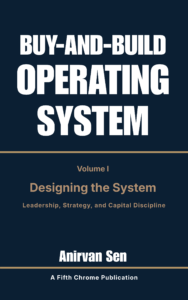
Then this book might be for you: Buy-and-Build Operating System Volume 1, available on all Amazon sites globally.
Visit Amazon in the US, UK, DE, FR, ES, IT, NL, JP, BR, CA, MX, AU, PL, SE, BE, IE, or IN to get your copy today.