The Investor’s Obligation:
CEO and Leadership Team: Success Is Not Management’s Problem Alone
Why leadership continuity in growth companies is an investor responsibility — and what governance demands in return
In the quiet deliberations of investment committees and boardrooms, few questions prove more consequential — or more persistently deferred — than this: Who is responsible when leadership fails to scale? This briefing examines the structural reality confronting investors in SMEs, mid-market, and early large enterprises, and argues that CEO and executive leadership team success is not a management problem to be diagnosed after the fact. It is a governance obligation to be designed from the outset.
LEADERSHIP EFFECTIVENESS IS A SYSTEM OUTCOME
Leadership transitions in growth companies are rarely isolated events. By the time a change in CEO or executive leadership becomes unavoidable, the conditions that produced that outcome have usually been accumulating for years. These conditions are not created by management alone. They are shaped, often quietly, by investors — through the expectations they set, the behaviours they reward, and the decisions they choose to defer.
That is an uncomfortable truth for many in the investment community. The instinct is to treat leadership failure as a management problem: to be diagnosed, addressed, and, if necessary, resolved through replacement. But in SMEs, mid-market businesses, and early-stage large enterprises, that framing misses the more consequential dynamic at work.
CEOs and executive teams do not operate in isolation. They function within systems of governance, capital allocation, incentive structures, and delegated authority. When those systems are aligned with the company’s stage of growth, leadership capacity compounds. When they are misaligned, even capable leaders become constrained. In the early years, leadership success is typically built on personal authority, speed of decision-making, and proximity to execution. As complexity increases, those same traits become liabilities unless the leadership model evolves alongside the business.
The transition from founder-led to institution-led is not exceptional. It is predictable. What varies is whether investors recognise and manage that transition with intention — or leave it to chance.
By the time leadership failure becomes visible, the governance conditions that allowed it have usually been in place for years.
When investors continue to assess leadership against outdated criteria, misalignment becomes structural. Performance may hold in the short term, but organisational capability does not keep pace with growth. The gap manifests gradually: as leadership strain, inconsistent execution, and deepening talent risk. By the time the performance data reflects it, the governance window has often closed.
CEO SUCCESS CANNOT BE SEPARATED FROM ELT STRENGTH
A CEO’s effectiveness in a scaling organisation is directly dependent on the capability and maturity of the Executive Leadership Team surrounding them. Yet ELT development and succession are consistently treated as secondary concerns, addressed when performance deteriorates, or attrition forces the conversation.
This is a structural error with compounding consequences. The ELT is where strategic intent is translated into operating reality. If decision authority remains concentrated at the CEO level because the team beneath lacks depth, confidence, or mandate, the organisation becomes increasingly fragile. The CEO compensates — often without fully recognising it — by becoming more operational precisely when the business requires greater leverage from the top. The result is a capable individual steadily becoming a bottleneck.
Investors who focus exclusively on CEO performance without examining ELT depth are evaluating half the system.
In such conditions, CEO succession without ELT readiness does not reduce risk. It compounds it. A new CEO inherits a team that has not been developed to lead independently, in an organisation that has not been structured to allow them to. Sustainable transition requires that ELT succession run ahead of, not behind, the CEO succession process.
THE OBLIGATION TO REDEFINE LEADERSHIP SUCCESS AT EVERY STAGE
One of the most consequential investor responsibilities is to redefine what effective leadership looks like as the company moves through stages of growth. This is not a periodic exercise. It is a continuous governance discipline.
What constitutes leadership effectiveness at one stage is frequently insufficient at the next. Founders are rewarded for decisiveness, conviction, and personal ownership. Scaling organisations require leaders who can build systems, distribute authority, and develop successors who do not depend on them. Executive leaders must evolve from functional excellence to enterprise stewardship.
When investors fail to explicitly reset these expectations, leadership teams default to the behaviours that previously delivered results. The business continues to grow, but leadership capability does not scale at the same rate. Over time, dependency replaces resilience. Clear, stage-appropriate leadership expectations are not a management courtesy. They are a governance requirement. Without them, succession becomes reactive rather than designed.
SUCCESSION IS A PROCESS, NOT A MOMENT
The organisations that handle leadership transitions well do not treat succession as a crisis response. They normalise it as an institutional discipline, embedding it into how leadership is developed, assessed, and renewed long before any specific transition is in prospect.
This requires a shift in how investors frame the conversation. Raising succession planning early does not signal dissatisfaction with the current CEO. It reflects institutional maturity. It communicates that future leadership capability is valued — not treated as someone else’s problem to solve at the eleventh hour.
When succession is deferred until it becomes urgent, investors are forced into compressed decisions under pressure. Authority transfers abruptly. Organisations destabilise. The cost of transition — in time, capital, and organisational confidence — rises materially. The businesses that emerge strongest from leadership transitions are those in which continuity was protected because succession was designed, not improvised.
The cost of deferred succession is rarely visible until it becomes unavoidable. By then, it is always higher than it needs to be.
THE INVESTOR AS STEWARD OF LEADERSHIP CONTINUITY
Effective investors in SMEs, mid-market enterprises, and early-stage large enterprises do not approach leadership succession as a periodic governance event. They treat it as a continuous responsibility embedded in their engagement with the business.
They pay attention to leadership depth, decision concentration, and dependency risk long before performance signals deteriorate. They understand that leadership failure rarely originates at the point where it becomes visible — it is usually the result of misaligned expectations and governance decisions that were delayed too long. They recognise their own role in creating the conditions in which leadership either compounds or constrains.
This demands a different quality of investor engagement: one that goes beyond capital allocation and board seat representation to include deliberate stewardship of leadership architecture. It requires asking not only whether the current CEO is performing, but whether the organisation is being built to outlast any individual — including the CEO it has today.
CEO and ELT transitions do not succeed or fail in isolation. They reflect the quality of investor stewardship across the full arc of the company’s growth. When leadership expectations evolve with the business, when ELT capability is built with deliberate intent, and when succession is treated as a governance discipline rather than a crisis response, transitions strengthen the organisation rather than expose it.
Leadership success and succession are not management accidents waiting to be corrected. They are governance outcomes that investors have both the responsibility and the authority to shape.
That responsibility cannot be delegated.
About This Briefing: This briefing is part of the Investor Leadership Series, examining how governance decisions shape CEO and executive team performance in SMEs, mid-market companies, and early-stage large enterprises. It is intended for investment principals, board chairs, and non-executive directors.
Where This Conversation Can Go Next
The ideas discussed here are part of the work we do at Fifth Chrome through SCALEUP and our Buy-and-Build Operating System — designed for leaders who are serious about building businesses that can scale, integrate, and compound.
If this resonates and you believe a deeper conversation would be valuable, you can reach us at scaleup@fifthchrome.com or buyandbuild@fifthchrome.com.
About Fifth Chrome
At Fifth Chrome, we specialize in helping companies unlock unprecedented opportunities through M&A, buy-and-build, scaling up, and leadership strategies. Whether you’re a Fortune 500 company, a mid-cap, or an SME, our expertise in M&A integration, leadership development, and strategic advisory services can help you achieve scalable growth with precision and speed.
Contact Us
Visit us at fifthchrome.com for more information on our services or to schedule a consultation.
Ready to Go Deeper?
Do you want to dive deeper into the stages of growth, their corresponding structures, leadership styles, and operational models?
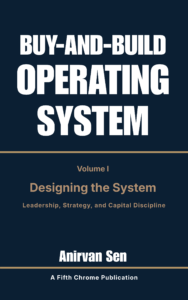
Then this book might be for you: Buy-and-Build Operating System Volume 1, available on all Amazon sites globally.
Visit Amazon in the US, UK, DE, FR, ES, IT, NL, JP, BR, CA, MX, AU, PL, SE, BE, IE, or IN to get your copy today.