From Operational Executor to Strategic Business Architect
What every CFO must do now to become PE-grade—before private equity arrives
Here is a reality that does not get spoken about enough. A large number of CFOs in businesses that get acquired by private equity will not be cut out for what comes next. Not because they are poor finance professionals. Not because they lack intelligence or dedication. But because the role they are walking into is categorically different from the role they have spent years mastering.
I say this not as a criticism but as a fair warning—and an opportunity. Because, unlike most structural challenges in business, this one is entirely solvable. If you are a CFO today, you can start building the skills of a PE-grade CFO right now, before any acquisition happens, before any sponsor arrives at your boardroom door.
The good news is that the required shift is less about technical knowledge and more about a fundamental reorientation in how you think, operate, and lead. It is the shift from operational executor to strategic partner and business architect. And it begins the moment you decide it does.
THE CFO ROLE IN A PE-BACKED ORGANISATION IS UNLIKE ANY OTHER
In a PE-backed environment, the CFO is not simply the head of finance. This person is the primary bridge between the investor and the business—responsible not only for the numbers but also for translating the company’s entire operating reality into language that a sponsor can understand, challenge, and act on.
That means the PE-grade CFO must carry capabilities that span far beyond traditional finance. They must be able to speak to operational performance with the depth of a COO. They must engage in capital allocation decisions and strategic trade-offs with the fluency of a CEO. And they must navigate leadership and cultural dynamics in ways historically reserved for a CHRO. All of this, simultaneously, in the same working week—which rapidly expands from forty hours to sixty, to eighty, and continues at that pace for months.
The PE-grade CFO is not the head of the finance function. They are a decision architect who happens to live in the numbers.
This is also, if you have the temperament for it, one of the most intellectually alive roles in business. Every day brings decisions that must be made quickly, grounded in data, and defended clearly. There is no hiding in the process. There is no waiting for the quarterly review cycle. The CFO who thrives in this environment is one who genuinely relishes that velocity—and who has trained themselves to operate with clarity under pressure.
THE GAP MOST CFOS DO NOT SEE COMING
The CFOs who struggle most in PE-backed environments are, counterintuitively, often the most experienced ones in the seller organization. They have been in their roles for years. They know the business deeply. They carry institutional knowledge that no one else possesses. And yet, precisely because they have operated within a seller-side culture for so long, the transformation required of them is the most dramatic.
Here is where the specific gaps most commonly surface.
Cash is a strategic asset, not a residual outcome. Many seller-side CFOs treat cash as a byproduct of the accounting cycle—something that gets reported, not managed. In PE, cash is the primary lever. Understanding daily and weekly cash positions, managing working capital as a competitive instrument, and knowing exactly how much runway exists at any given moment are not reporting functions. It is a strategic discipline. CFOs who have operated as bookkeepers or controllers—however excellent—often need to reset their relationship with cash fundamentally.
Capital allocation as a decision architecture. In many SMEs and mid-market businesses, the CFO provides input into capital allocation decisions, but the CEO or founder makes the call. The muscle of actually thinking through competing investment options against return hurdle rates, strategic timing, and portfolio trade-offs is therefore underdeveloped. In PE, the CFO is expected to architect those trade-offs, not merely present the data behind them.
Leading indicators, not lagging reports. Seller-side CFOs are often exceptional at explaining what happened. PE demands CFOs who can predict what will happen—and who can identify the two or three leading indicators that will tell you six weeks in advance whether the business is on track. This is a different analytical mindset entirely. It requires building predictive models, not just accurate historical reports.
Velocity and decisiveness under uncertainty. One of the most telling patterns I have observed—and which was confirmed in a recent podcast conversation—is CFOs who respond to sponsor requests with a flat refusal: “That cannot be done in two weeks.” What they mean, if they are being precise, is that they have never done it in two weeks. In PE, 80 percent certainty now is almost always more valuable than 100 percent certainty in three months. The CFO who cannot operate with that calculus will consistently frustrate the sponsor relationship.
Cross-functional leadership credibility. Because the CFO is the primary business interpreter for the sponsor, they must be able to engage credibly on operational, commercial, and people dimensions—not just financial ones. This requires building genuine relationships across the leadership team and understanding the business at a level that goes well beyond the P&L.
THE MOST IMPORTANT THING TO PRESERVE
Before we discuss what needs to change, it is worth being clear about what must not change—and what is, in fact, irreplaceable.
The CFO who has been with a business through its formative years carries something that no newly appointed PE-grade hire can replicate: tribal knowledge. The understanding of why certain decisions were made, how particular relationships were built, and where the bodies are buried in terms of operational history. This contextual intelligence is genuinely valuable in a PE transition. It reduces the cost of integration. It builds trust with the new sponsor faster. It prevents the organization from losing institutional memory at exactly the moment when that memory is most needed.
The goal is not to become someone else. It is to expand your range so that your existing depth has a much larger arena in which to operate.
The CFO who approaches the PE transition as an opportunity to layer new capabilities onto genuine business knowledge—rather than feeling threatened by the new demands—will almost always outperform the newly installed external hire who lacks that foundation.
HOW TO BUILD PE-GRADE CAPABILITY BEFORE PE ARRIVES
The most powerful move available to any CFO today is to proactively begin this transformation. The skills of a PE-grade CFO are not a mystery. They are learnable. And the organizations that will benefit most are those whose CFOs arrive at the PE transition already operating at that level.
Here is where to focus.
- Own the cash conversation completely. Start producing weekly cash flow forecasts even if no one is asking for them—model working capital scenarios. Understand the levers that move cash in and out of the business with the same precision you apply to the income statement.
- Build a capital allocation framework. Begin mapping the investment decisions in your business—capex, headcount, M&A—against explicit return criteria. Introduce the language of hurdle rates, payback periods, and portfolio trade-offs into your conversations with the CEO and board, even informally.
- Develop and champion leading indicators. Identify the three to five metrics that predict your company’s financial performance before it shows up in the numbers. Track them obsessively. Report them alongside the historical results. Train your team to think in leading terms, not lagging ones.
- Compress your reporting timelines deliberately. If your monthly close takes fifteen days, make it ten. Then make it seven. The discipline of producing accurate information faster is a muscle that must be built before it is demanded.
- Engage commercially and operationally. Attend customer meetings. Sit in on operational reviews. Understand the commercial model deeply enough to explain it to an investor with the same fluency as the sales director. This is not overreach—it is role expansion.
- Seek exposure to investment-backed environments. Advisory boards, NED roles, peer networks of PE-backed CFOs—any exposure to how financial leadership operates in those environments is compounding capital for your career.
THE OPPORTUNITY IS NOW
The CFO role in a PE-backed organization is, in my view, the most demanding and consequential role in the entire journey—arguably more so than the CEO, because the CEO leads the business. At the same time, the CFO manages the business and investor relations simultaneously.
The CFOs who will be ready for that role are not waiting for PE to arrive and then scrambling to adapt. They are making the shift now—deliberately, systematically, and fully aware that the version of themselves required in eighteen months will not be the same one that has served them well until today.
The gap between a good seller-side CFO and a PE-grade CFO is real. But it is not fixed. It is a choice.
Start making it.
About the Author
Anirvan Sen is the founder of Fifth Chrome and the author of the Buy-and-Build Operating System, a three-volume framework for building, scaling, and institutionalizing multi-acquisition growth businesses, available on Amazon. Fifth Chrome advises PE firms, family offices, and mid-market businesses on buy-and-build strategy, leadership advisory, and executive education.
About This Briefing: This article is part of the Fifth Chrome Buy-and-Build Leadership Series, which examines how leadership architecture and people decisions shape value creation throughout the buy-and-build journey. It is intended for CEOs, investment principals, operating partners, and board members of mid-market and PE-backed businesses.
Where This Conversation Can Go Next
The ideas discussed here are part of the work we do at Fifth Chrome through SCALEUP and our Buy-and-Build Operating System — designed for leaders who are serious about building businesses that can scale, integrate, and compound.
If this resonates and you believe a deeper conversation would be valuable, you can reach us at scaleup@fifthchrome.com or buyandbuild@fifthchrome.com.
About Fifth Chrome
At Fifth Chrome, we specialize in helping companies unlock unprecedented opportunities through M&A, buy-and-build, scaling up, and leadership strategies. Whether you’re a Fortune 500 company, a mid-cap, or an SME, our expertise in M&A integration, leadership development, and strategic advisory services can help you achieve scalable growth with precision and speed.
Contact Us
Visit us at fifthchrome.com for more information on our services or to schedule a consultation.
Ready to Go Deeper?
Do you want to dive deeper into the stages of growth, their corresponding structures, leadership styles, and operational models?
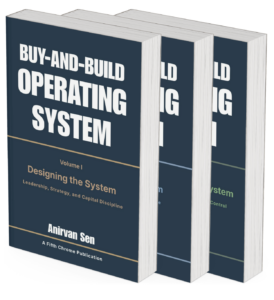
Then this book might be for you: Buy-and-Build Operating System, 3-volume set, available on all Amazon sites globally.
Visit Amazon in the US, UK, DE, FR, ES, IT, NL, JP, BR, CA, MX, AU, PL, SE, BE, IE, or IN to get your copy today.