Why the first control point in any acquisition is cash position—not the growth story.
Anirvan Sen · August 2026
◆
A proverb gets repeated so often in boardrooms that it has started to lose its meaning: cash is king. Said enough times, it becomes wallpaper — a truth everyone nods at, and few actually operationalize. And yet nowhere is it more literally true, more immediately consequential, than in the small and mid-market segment where most buy-and-build activity happens. In this segment, and arguably at every scale, an organization’s health is not measured by what it reports. It is measured by what it can pay.
◆ ◆ ◆
THE STORY REVENUE TELLS
Most organizations — and most acquirers evaluating them — instinctively reach for revenue as the headline measure of health. Revenue is visible, comparable across periods, and easy to build a growth narrative around. On its own, it is also close to meaningless as a signal of operational resilience.
Revenue is recognized, not realized. An invoice raised is not cash collected. A contract signed is not cash in the bank. In founder-led and early platform-formation businesses, this gap is often widest, and least visible from the outside. Growth on the P&L can sit directly on top of stretched payables, factored receivables, or a founder’s personal loan quietly plugging a working capital hole that never makes it into the data room narrative.
None of this shows up cleanly in a growth chart. It shows up in the bank balance three weeks after close, when the new owner discovers that the business they bought converts revenue into cash far more slowly, and far less reliably, than the diligence materials suggested.
◆ ◆ ◆
THE DAY OWNERSHIP CHANGES HANDS
Diligence tests assumptions. Ownership tests reality.
The moment a transaction closes, the acquirer inherits the business’s actual cash position — not the adjusted EBITDA bridge, not the normalized working capital assumption, not the management deck’s confident narrative about collections. Whatever gap existed between the story and the cash was always going to surface. Close day is simply when it stops being a diligence question and starts being an operating one.
This is precisely why cash — not revenue, not even EBITDA — deserves to be the first thing a new owner takes control of. Not because revenue and profitability don’t matter, but because cash is the constraint that determines whether the business survives long enough for the growth thesis to play out at all.
A revenue growth story funded on someone else’s runway is not a platform. It is a countdown.
◆ ◆ ◆
TAKING CONTROL — THE FIRST MOVE, NOT THE SECOND
There is a natural temptation, especially in a buy-and-build strategy, to spend the first hundred days chasing the synergy case: cross-selling, bolt-on integration, commercial upside. All of that matters. None of it matters if the platform runs out of cash first.
Taking control of cash management ahead of taking control of the growth agenda is not a finance-department nicety. It is the leadership discipline that determines whether every other plan gets the runway to work. In practice, for a newly acquired platform business, that control point looks like this:
DAY-ONE CASH DIAGNOSTIC
- Rolling 13-week cash flow visibility, built and owned centrally — not inherited unchanged from the seller’s finance function.
- Confirmed signing authority and banking access, so control is real on Day One, not assumed.
- A baseline read on DSO and DPO against sector norms, to separate genuine performance from timing artefacts.
- Covenant and facility headroom mapped against the actual — not projected — cash position.
- A short list of customer concentration and payment-term risks inherited with the acquisition.
None of these steps require sophisticated systems or months of runway. They require someone on the new leadership team treating cash visibility as a Day One deliverable, not a Month Three finance project.
◆ ◆ ◆
WHY THIS COMPOUNDS IN BUY-AND-BUILD
In a single-asset acquisition, a cash surprise is a single problem. In a buy-and-build platform, it multiplies.
Each bolt-on brings its own cash rhythm — its own collection cycle, its own supplier terms, its own seasonal swings — layered onto a platform that is usually already carrying acquisition debt. Without consolidated visibility from the first acquisition onward, a platform can look robust on a combined P&L while individual entities are quietly cannibalizing group liquidity to cover their own gaps. By the time this becomes visible at the group level, it is usually well embedded across two or three portfolio companies, not one.
This is why cash discipline should never be treated as a concern to formalize once a platform has “earned” proper financial governance further down the road. It belongs at the very first stage — in the founder-led base — before the first acquisition is even signed.
◆ ◆ ◆
A LEADERSHIP DISCIPLINE, NOT JUST A FINANCE ONE
It is tempting to treat cash management as a CFO’s problem — a technical, back-office discipline that leadership can delegate and revisit later. That framing gets the sequence backwards. How quickly and rigorously a new leadership team takes control of cash after an acquisition says as much about their operating discipline as any strategic decision they will make that year.
Revenue tells a story about ambition. Cash tells the truth about whether the business can fund it. In the buy-and-build journey — in the SME and lower-mid-market segment, and frankly at every scale — the leadership teams who win are the ones who read the second number first.
◆ ◆ ◆
ABOUT THE AUTHOR
Anirvan Sen is a business strategist, author, and the CEO and Founder of Fifth Chrome — advising CEOs, PE investors, family offices, and Fortune 500 organizations on strategy, leadership, transformation, a nd M&A. He is the creator of the Buy-and-Build Operating System framework and the author of multiple books on M&A, leadership, strategy, and organizational design.
Where This Conversation Can Go Next
The ideas discussed here are part of the work we do at Fifth Chrome through SCALEUP and our Buy-and-Build Operating System — designed for leaders who are serious about building businesses that can scale, integrate, and compound.
If this resonates and you believe a deeper conversation would be valuable, you can reach us at scaleup@fifthchrome.com or buyandbuild@fifthchrome.com.
About Fifth Chrome
At Fifth Chrome, we specialize in helping companies unlock unprecedented opportunities through M&A, buy-and-build, scaling up, and leadership strategies. Whether you’re a Fortune 500 company, a mid-cap, or an SME, our expertise in M&A integration, leadership development, and strategic advisory services can help you achieve scalable growth with precision and speed.
Contact Us
Visit us at fifthchrome.com for more information on our services or to schedule a consultation.
Ready to Go Deeper?
Do you want to dive deeper into the stages of growth, their corresponding structures, leadership styles, and operational models?
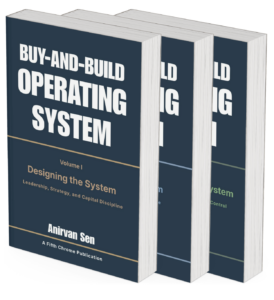
Then this book might be for you: Buy-and-Build Operating System, 3-volume set, available on all Amazon sites globally.
Visit Amazon in the US, UK, DE, FR, ES, IT, NL, JP, BR, CA, MX, AU, PL, SE, BE, IE, or IN to get your copy today.