When the Plan Stops Matching Reality
It is late September. The board convenes for the quarterly review. The numbers are not disastrous. Several initiatives are on track. Governance boxes have been ticked.
And yet, everyone in the room senses the same uncomfortable truth. The world against which that plan was built no longer exists in quite the same form.
Artificial intelligence has rewritten productivity expectations. A competitor has emerged from outside the traditional industry boundary. Customer acquisition economics have shifted. Capability gaps have surfaced because skills considered strategically important months ago are already being redefined.
Still, the organization keeps executing — not because leadership believes the assumptions remain valid, but because changing direction inside a large enterprise is expensive, politically awkward, and operationally disruptive. Reforecasting triggers budget battles. Functional leaders defend existing priorities—governance systems’ slow adaptation precisely when adaptation becomes necessary.
Organizations are not failing because they cannot execute. They are failing because they are executing with discipline against assumptions that have already expired.
That observation raises the deeper question this article confronts: if the external world now changes at a fundamentally different pace, should the enterprise’s operating rhythm change with it?
Management Was Built for a Different Economic Clock
It is tempting to dismiss legacy operating models as relics. That is intellectually lazy.
Annual planning cycles, budget-led governance, layered approvals, fixed structures, long implementation timelines — none of this was poorly designed. It was exceptionally well designed for the environment in which it emerged: slower information flows, clearer competitive boundaries, more predictable industry structures, and longer technology adoption cycles. Strategy could reasonably be set annually because core assumptions were unlikely to become materially obsolete within weeks.
That model rewarded predictability, control, scale, and optimization — qualities that compounded into extraordinary corporate performance across generations.
The problem is not that it was flawed. The problem is that its underlying environmental assumptions are now misaligned with reality. What once created efficiency is beginning to create drag.
The Compression of Strategic Time
Executives have always dealt with disruption. Markets have never been entirely stable. What is different now is not the presence of uncertainty, but the compression of strategic time itself.
Multiple forces are collapsing decision windows simultaneously:
- Technology compression. Capabilities move from experimental curiosity to operational expectation within months rather than years.
- Competitive unpredictability. Threats emerge from adjacent sectors, platform businesses, and entirely different business models — not familiar incumbents.
- Capability decay. The shelf life of leadership competence and operating assumptions is shortening.
- Customer expectation migration. Customers benchmark against the best they encounter anywhere, not within your category.
- Capital impatience. Investors expect visible responsiveness, sharper allocation, and faster execution learning loops.
The half-life of strategic assumptions has shortened. The issue is not strategic intelligence. It is organizational cadence.
Why the 90-Day Enterprise Deserves Serious Strategic Attention
If annual cycles are too slow, the obvious question is what replaces them.
Not 30-day tactical panic. Not daily executive improvisation. Not perpetual organizational agitation disguised as agility.
The answer lies in the 90-day enterprise — not as a reporting mechanism, but as the operating rhythm of the organization itself.
Its power lies in balance. A 30-day cycle is too compressed for meaningful enterprise execution; teams spend disproportionate time mobilizing, aligning, and reporting rather than delivering. A 12-month cycle now creates the opposite risk: by the time meaningful learning emerges, the environment has already moved.
A 90-day horizon occupies the strategically productive middle. Short enough to create urgency. Long enough to deliver. Within a well-designed cycle, organizations can launch serious cross-functional initiatives, test strategic assumptions against the market, observe meaningful performance signals, reallocate capital and leadership attention, terminate weak initiatives before they become expensive distractions, and scale emerging winners with conviction.
This is not speed for its own sake. It is the institutionalization of a disciplined strategic learning rhythm.
This Is Bigger Than Agile, OKRs, or Quarterly Reviews
The easiest mistake would be to misclassify the idea.
The 90-day enterprise is not Agile in enterprise clothing — Agile emerged as a software-rooted execution philosophy, built around iterative delivery and customer feedback loops. It is not quarterly KPI reporting; reviewing numbers every three months is not adaptive strategic management. It is not synonymous with OKRs, which are a goal-setting discipline rather than an operating model. And it is not Jack Welch’s Work-Out, which was a powerful assault on bureaucracy, but a narrower ambition.
The 90-day enterprise is broader. It is an enterprise operating rhythm — a structural cadence that connects strategic intent, execution discipline, governance, learning, and adaptation.
That requires more than process adoption. It requires leadership redesign.
The Architecture of the 90-Day Enterprise
A common objection is that shorter cycles imply short-termism. The opposite is true. Without long-term clarity, shorter cycles become chaos. With strategic discipline, they become extraordinarily powerful.
A coherent operating model aligns multiple time horizons:
- 3–5 year strategic horizon — the intended future state, sources of advantage, and capability aspirations.
- Annual strategic intent — the major directional priorities of the current year.
- 90-day enterprise missions — concentrated execution priorities that translate intent into action.
- Monthly governance reviews — decision forums for intervention, escalation, and reallocation.
- Weekly operating cadence — execution momentum, issue resolution, and accountability.
- Daily decision velocity — frontline responsiveness where real execution occurs.
Organizations fail when these horizons disconnect. Long-term strategy without adaptive execution becomes theatre. Short-term activity without strategic coherence becomes noise. The discipline lies in integrating both.
Leadership Will Be the Real Constraint
Most organizations will assume this is a systems design challenge. In reality, it is first a leadership challenge.
Traditional environments rewarded leaders who excelled at predictability, control, and structured execution against stable assumptions. Those capabilities remain valuable. They are no longer sufficient.
The adaptive enterprise requires leaders capable of making consequential decisions with incomplete information, operating across functional boundaries rather than defending silos, reallocating resources dynamically rather than annually, terminating initiatives without emotional attachment, tolerating ambiguity without paralysis, and learning quickly without interpreting adaptation as strategic weakness.
This is as much a psychological shift as an operational one. Some executives will thrive. Others, whose authority was built around control and predictability, may find the model profoundly uncomfortable. That discomfort is not a side effect. It is central to the transformation.
Where This Will Go Wrong
Every promising management idea is vulnerable to poor execution. The 90-day enterprise will be no exception.
Some organizations will interpret speed as virtue and create quarterly chaos. Others will overload the enterprise with too many simultaneous initiatives, destroying focus while pretending to create agility. Some will produce metric inflation rather than strategic clarity. A common failure will be superficial adoption — preserving old bureaucracy while accelerating the meeting calendar. That creates the worst possible outcome: fast-looking inertia.
The most dangerous failure mode is strategic drift. Without a clearly defined long-term direction, repeated 90-day cycles degenerate into tactical opportunism. Organizations become busy, adaptive-looking, and directionally incoherent.
The discipline is not shorter cycles. The discipline is a structured adaptation.
The Emerging Competitive Advantage: Operating Rhythm
Historically, competitive advantage was built through scale, efficiency, intellectual property, distribution, or capital. Then the strategy itself became a major differentiator. Increasingly, another dimension is emerging as equally decisive — superiority in operating rhythm.
The organizations that outperform may not always begin with better strategies. They will win because they sense environmental change faster, translate insight into execution faster, reallocate talent and capital faster, and institutionalize learning faster — while slower competitors remain trapped in annual management cycles.
This is not a marginal advantage. It is structural. And structural advantages compound.
Final Reflection
The annual plan is not becoming obsolete because planning itself has failed. It is becoming insufficient because reality is outpacing the institutional machinery designed to respond to it.
The organizations that win in the next decade will not be those with the smartest strategies at the outset. They will be those whose management architecture allows them to remain strategically relevant as the environment continues to shift.
The question for boards, CEOs, and investors is no longer, “What is our strategy?” It is, “What operating rhythm allows us to remain strategically intelligent while reality keeps changing?”
About the Author
Anirvan Sen is a business strategist, author, and the CEO and Founder of Fifth Chrome — advising CEOs, PE investors, family offices, and Fortune 500 organizations on strategy, leadership, and transformation. He is the creator of the ELITE Leadership framework and the author of multiple books on M&A, integration, and organizational design.
AFTER NOTE · ELITE LEADERSHIP
This article reflects themes at the heart of ELITE Leadership — Anirvan Sen’s forthcoming book on leading organizations in the Unscripted Era. The framework builds five interlocking capabilities: Expanded Strategic Thinking, Leading Across Boundaries, Innovation Everywhere, Technology-Talent Duality, and Experience and Execution Edge. Exploring and configuring new-Age Web-Shaped expertise is one of the elements considered under ELITE Leadership.
To continue the conversation, you can reach out at info@fifthchrome.com or ELITE@fifthchrome.com.
About Fifth Chrome
At Fifth Chrome, we specialize in helping companies unlock unprecedented opportunities through M&A, buy-and-build, scaling up, and leadership strategies. Whether you’re a Fortune 500 company, mid-cap, or SME, our expertise in M&A integration, leadership development, and strategic advisory can help you achieve scalable growth with precision and speed.
Contact Us
Visit us at fifthchrome.com for more information on our services or to schedule a consultation.
ELITE Leadership
The Leader’s Playbook for the Unscripted Era
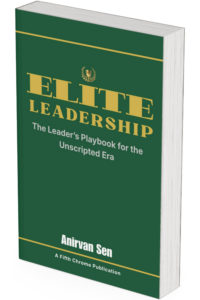
To learn more about such topics, get a copy of the upcoming book, ELITE Leadership, available on all Amazon sites globally.
Visit Amazon in the US, UK, DE, FR, ES, IT, NL, JP, BR, CA, MX, AU, or IN to get your copy today.