A private equity firm acquires a promising software platform. The thesis is sound: organic acceleration, two bolt-ons in the first eighteen months, margin discipline throughout. The first quarter feels like vindication — new initiatives launch, reporting tightens, the organization visibly accelerates. Then, by month six, the cracks appear. The same dozen high performers are carrying every initiative. Critical roles have been open for two quarters. The first bolt-on has landed, and nobody has the capacity to integrate it. The pipeline of opportunities is intact; the pipeline of people is empty.
The board’s instinct is to question the strategy. The strategy is fine. What broke is something the investment memo never priced: the platform’s capacity to recruit at buy-and-build speed. Capital today is abundant, mobile, and largely undifferentiated — any credible thesis can find funding. What capital cannot buy off the shelf is a hiring engine that runs at the cadence of the deal model. And because recruitment is governed as an administrative cost rather than underwritten as a value driver, it is systematically underpriced — by deal teams, by boards, and by the platforms themselves. That mispricing is also the opportunity. In a market where every fund deploys the same money against the same targets, the recruitment engine is one of the few levers still cheap relative to its return.
Investment committees stress-test every assumption in a growth plan except the one that breaks first — and it breaks by month six, not month twenty-four.
The Engine Was Built for a Different Job
Consider what a typical platform company actually brings to the table. It has a recruitment cell, often competent within its mandate. But that mandate is replacement. Hiring is triggered by departure: someone resigns, a requisition opens, a search begins. Roles are filled sequentially, one vacancy at a time, with the hiring manager acting as a part-time recruiter who squeezes interviews between operational duties. The function is measured on time-to-fill, not quality-of-hire — and under that metric, the available candidate beats the right candidate every time. The predictable result is a hiring pattern that drifts toward average and below average, and a mis-hire rate that, in our experience, can reach one in three. None of this is incompetence. The function is performing exactly the job it was designed for. It was designed for the wrong job.
The demand profile of a buy-and-build is not merely larger than steady-state; it is categorically different. The platform must hire proactively, ahead of need rather than after departure. It must hire in parallel across functions and geographies, not sequentially. It must raise the bar with every hire while simultaneously absorbing the people who arrive with each bolt-on and backfilling the departures triggered by every transaction. A function engineered to fill one seat at a time cannot do four of these things concurrently — and no amount of urgency from the deal team will make it able to. The platform buys at deal speed and hires at replacement speed, and the value plan quietly drains into the gap between the two.
In a steady-state business, a mis-hire is a survivable annoyance. In a buy-and-build, it is a thesis-killer — because the hold period does not grant the time for a second attempt.
This is why the recruitment engine belongs among the earliest capital allocation decisions of the hold period, alongside the ERP consolidation and the pricing review. Talent mapping conducted before vacancies exist. A calibrated hiring bar owned by leadership rather than delegated to whoever happens to be interviewing. Dedicated recruiting capacity sized to the acquisition cadence, not to last year’s attrition. Assessment rigor proportionate to what each seat contributes to the thesis. Funded and governed as infrastructure — because in a talent-centric business, that is precisely what it is.
Why the Engine Is Starved
If the recruitment engine matters this much, why is it so reliably underfunded? Because of a category error in how businesses classify their people. In talent-centric enterprises — software firms, law firms, consultancies, engineering and design organizations, accounting practices — talent is not a resource that executes the strategy. Talent is the productive asset itself. A manufacturer buys machinery to add capacity; a software company hires engineers; a professional services firm acquires expertise and relationships. The primary productive asset walks out of the building every evening. Economically, hiring is capital deployment.
Yet most organizations govern it through entirely different machinery. A two-million-euro technology investment goes to the board with a return case, sensitivities, and an owner. A two-million-euro headcount expansion is delegated to HR, evaluated on a requisition-by-requisition basis, and discussed in the language of cost control. The first conversation asks where value will be created. The second asks how spending can be contained. Same capital, opposite governance — and the engine that deploys the most important capital in the business is run on the budget of a back-office service.
What the Engine Should Hire For
A recruitment engine running at deal speed is necessary but not sufficient. Speed, when pointed at the wrong roles, builds the wrong organization faster. The question disciplined leadership teams ask is not how many people the business needs, but where talent capital should be deployed to create the greatest enterprise value — and that question has structure.
The Talent Capital Allocation Pyramid
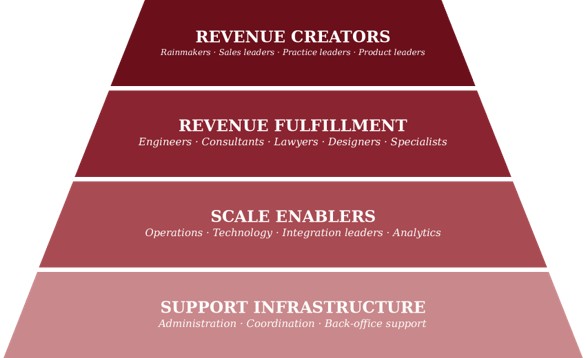
Revenue creators directly generate, unlock, or accelerate revenue; they are the highest-leverage talent capital in the business and the layer most often underfunded relative to its return. Revenue fulfillment talent converts sold work into delivered value; without depth here, every commercial success becomes a delivery crisis. Scale enablers raise everyone else’s productivity; their return is multiplicative rather than additive, which is precisely why conventional headcount logic undervalues them. Support infrastructure keeps the organization running — necessary, and yet the layer where founder-led and acquired businesses most reliably accumulate overhead faster than value.
The problem, to be clear, is not support functions. The problem is over-investing in the base of the pyramid before investing sufficiently in its upper layers. Many businesses build overhead faster than capability without ever deciding to — layers form, complexity compounds, and the cost base grows while the productive core does not. The ratio of investment across these four layers tells you more about a platform’s trajectory than its pipeline does, and it is a ratio almost no board currently owns.
What Protects the Return: Absorption
Even a well-aimed engine running at full speed encounters a final failure mode. Organizations assume that hiring talent creates value. It does not — any more than purchasing machinery creates output before it is installed, commissioned, and integrated into the production line. Most companies believe they have a recruitment challenge; past the engine problem, what they actually have is a talent absorption challenge. Absorption is what converts a hire into a return, and it runs through four stages.
| I
Acquisition Finding and securing the right talent, ahead of need |
II
Assimilation Making new talent productive, trusted, and effective |
III
Stabilization Retaining talent through the turbulence of growth |
IV
Renewal Continuously upgrading capability as the bar rises |
Every senior hire arrives carrying habits, assumptions, and operating models built elsewhere. They must learn how decisions are actually made, where informal power lies, and how credibility is earned in this particular system. None of that appears on an organization chart, and none of it happens on the timeline the business case assumed. Meanwhile, the existing workforce is grappling with the consequences of growth: new leaders arrive above people who expected promotion, standards rise, and practices that built the company are challenged by people who did not build it. Incoming talent grows frustrated by inertia; incumbents grow skeptical of outsiders; high performers grow exhausted carrying both the business and its transformation. These tensions are not signs of failure. They are the predictable physics of growth.
You are not onboarding people. You are onboarding the organization to those people.
This is where buy-and-build strategies break first, because acquisitions can be completed faster than organizations can absorb them. The symptoms are familiar to anyone who has sat through a stalled integration: delays, leadership bottlenecks, elevated turnover, cultural fragmentation, and execution that slows as the platform grows. The limiting factor is rarely acquisition opportunity, capital, or market demand. It is the organization’s capacity to absorb talent at the pace the strategy generates it — and that capacity, like the engine that feeds it, must be deliberately built. It never emerges on its own.
The Fifth Chrome Diagnostic
- Is our recruitment function built for replacement or for growth — and when did it last hire proactively, in parallel, against a calibrated bar?
- Can we name the ten individuals this plan depends on — and what happens to the thesis if three of them leave in the first year?
- What is the ratio of hiring investment across revenue creators, revenue fulfillment, and scale enablers — and who owns that ratio at board level?
- How long does it actually take for a senior hire to become fully effective in this organization, and is that time included in the model?
- What is our demonstrated absorption rate — how many acquisitions, new leaders, and major initiatives has this organization successfully metabolized in a single year?
- If the growth plan succeeds commercially, where does the organization break first — and what are we doing about it now?
The Board’s Real Question
For CEOs, investors, and boards, the shift required is conceptual before it is operational. Recruitment is not an administrative process, and talent is not an HR expense to be benchmarked against revenue. In a talent-centric business, the hiring engine is the machinery that deploys the company’s most consequential capital — and in a buy-and-build, it is the lever whose price has not yet caught up with its return. Growth rarely stalls because organizations run out of opportunity. It stalls because organizational capability grows more slowly than ambition, and because no one in the governance chain was held accountable for closing that gap.
The companies that consistently outperform in buy-and-build environments do not simply acquire businesses. They acquire talent capacity. The winners are not the organizations that hire the most people. They are the organizations that build the engine to hire at deal speed, allocate talent capital where it creates the greatest enterprise value, and absorb it effectively — quarter after quarter, transaction after transaction, ahead of the ambition rather than behind it.
Where This Conversation Can Go Next
The ideas discussed here are part of the work we do at Fifth Chrome through SCALEUP and our Buy-and-Build Operating System — designed for leaders who are serious about building businesses that can scale, integrate, and compound.
If this resonates and you believe a deeper conversation would be valuable, you can reach us at scaleup@fifthchrome.com or buyandbuild@fifthchrome.com.
About Fifth Chrome
At Fifth Chrome, we specialize in helping companies unlock unprecedented opportunities through M&A, buy-and-build, scaling up, and leadership strategies. Whether you’re a Fortune 500 company, a mid-cap, or an SME, our expertise in M&A integration, leadership development, and strategic advisory services can help you achieve scalable growth with precision and speed.
Contact Us
Visit us at fifthchrome.com for more information on our services or to schedule a consultation.
Ready to Go Deeper?
Do you want to dive deeper into the stages of growth, their corresponding structures, leadership styles, and operational models?
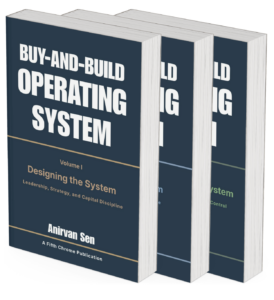
Then this book might be for you: Buy-and-Build Operating System, 3-volume set, available on all Amazon sites globally.
Visit Amazon in the US, UK, DE, FR, ES, IT, NL, JP, BR, CA, MX, AU, PL, SE, BE, IE, or IN to get your copy today.