Leadership in the Unscripted Era
The first week of the 30 Days of ELITE Leadership journey explored a reality that many leaders experience but few explicitly acknowledge: the environment in which leadership operates has changed fundamentally.
Many leadership models, development programs, organizational structures, and strategic planning approaches were designed for a world that was more predictable, hierarchical, and functionally structured. Yet today’s leaders operate in an environment shaped by continuous disruption, technological acceleration, shifting workforce expectations, evolving customer behaviors, and unprecedented uncertainty.
The challenge facing organizations is not that traditional leadership practices have become irrelevant. The challenge is that they are no longer sufficient.
Leadership Competencies Are Evolving Faster Than Most Organizations Realize
Organizations continue to invest heavily in leadership development. However, much of that investment remains anchored in competencies that were developed for a different era.
Today’s leaders must navigate uncertainty, lead across organizational boundaries, orchestrate human and technological capabilities, foster innovation, and manage increasingly complex stakeholder ecosystems. Leadership is no longer simply about directing teams and executing plans. It is about enabling adaptation in environments where certainty is becoming increasingly scarce.
The critical question for leaders is no longer whether they are developing capabilities. It is whether they are developing the capabilities that the future demands.
Strategy Is No Longer About Predicting the Future
For decades, strategy was often viewed as a forecasting exercise. Organizations attempted to predict future conditions and then build plans around those predictions.
The challenge is that many of the assumptions underpinning long-term plans now expire much faster than before. Market conditions, technologies, customer expectations, competitive landscapes, and regulatory environments can shift dramatically within months rather than years.
The most effective organizations are increasingly replacing prediction with adaptability. They establish a clear strategic direction—a North Star—and then continuously adjust their course as conditions evolve.
In the Unscripted Era, adaptability has become a strategic capability.
Engage-and-Enable Is Replacing Command-and-Control
Traditional command-and-control leadership evolved in a world where information was scarce, and decision-making authority was concentrated at the top of organizational hierarchies.
Today, information is distributed, expertise exists across multiple levels of the organization, and problems often require rapid responses from those closest to the issue.
As a result, leadership is shifting from directing and controlling toward engaging and enabling. Leaders create value by removing barriers, empowering decision-making, fostering collaboration, and creating the conditions for people to succeed.
Organizations that continue to rely exclusively on hierarchy often find themselves slower, less adaptive, and less innovative than their competitors.
Innovation Happens Where Experiences Are Created
Innovation is frequently associated with research laboratories, product development teams, and dedicated innovation departments.
Yet many of the most valuable opportunities for innovation emerge far from formal innovation structures. They emerge wherever customers, employees, partners, and stakeholders interact with products, services, systems, and processes.
Every point of friction, every unmet need, and every inefficiency contains the innovation potential.
Organizations that democratize innovation and encourage experimentation across the enterprise are often better positioned to identify emerging opportunities than those that confine innovation to a small group of specialists.
Workforce Planning Is No Longer About Headcount
Traditional workforce planning focused on determining how many people an organization required to achieve its objectives.
Today, the question is significantly more complex.
Leaders must increasingly determine the optimal combination of human capability, artificial intelligence, automation, technology platforms, partners, contractors, and gig-economy talent.
The future of work is not a choice between people and technology. It is about creating systems where human and technological capabilities amplify each other.
Organizations that continue to think exclusively in terms of headcount may find themselves competing against organizations that think in terms of capability ecosystems.
The Emerging Leadership Reality
Although these five ideas appear distinct, they point toward the same conclusion.
Leadership is entering an era in which uncertainty is permanent, adaptation is continuous, innovation is distributed, authority is increasingly decentralized, and competitive advantage emerges from integrating people, technology, strategy, and experience.
The organizations that thrive in this environment will not necessarily be those with the most resources, the most detailed plans, or the most sophisticated hierarchies.
They will be the organizations that learn faster, adapt faster, orchestrate better, and continuously evolve their leadership capabilities.
This is the central challenge explored throughout ELITE Leadership.
The future will not wait for organizations to catch up.
The question for leaders is whether they are evolving as quickly as the environment around them.
This article captures the key themes from Week 1 of the 30 Days of ELITE Leadership journey.
Every weekday, I share one leadership principle, two insights, and three leadership actions designed to help leaders navigate complexity, uncertainty, technology disruption, innovation, and experience-led transformation.
Follow the daily series for the remaining principles and reflections.
#30DaysOfELITELeadership
About the Author
Anirvan Sen is a business strategist, author, and the CEO and Founder of Fifth Chrome — advising CEOs, PE investors, family offices, and Fortune 500 organizations on strategy, leadership, and transformation. He is the creator of the ELITE Leadership framework and the author of multiple books on M&A, integration, and organizational design.
AFTER NOTE · ELITE LEADERSHIP
This article reflects themes at the heart of ELITE Leadership — Anirvan Sen’s forthcoming book on leading organizations in the Unscripted Era. The framework builds five interlocking capabilities: Expanded Strategic Thinking, Leading Across Boundaries, Innovation Everywhere, Technology-Talent Duality, and Experience and Execution Edge. Exploring and configuring new-Age Web-Shaped expertise is one of the elements considered under ELITE Leadership.
To continue the conversation, you can reach out at info@fifthchrome.com or ELITE@fifthchrome.com.
About Fifth Chrome
At Fifth Chrome, we specialize in helping companies unlock unprecedented opportunities through M&A, buy-and-build, scaling up, and leadership strategies. Whether you’re a Fortune 500 company, mid-cap, or SME, our expertise in M&A integration, leadership development, and strategic advisory can help you achieve scalable growth with precision and speed.
Contact Us
Visit us at fifthchrome.com for more information on our services or to schedule a consultation.
ELITE Leadership
The Leader’s Playbook for the Unscripted Era
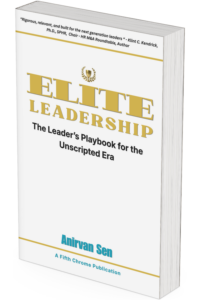
To learn more about such topics, get a copy of my new book, ELITE Leadership, available on all Amazon sites globally.
Visit Amazon in the US, UK, DE, FR, ES, IT, NL, JP, BR, CA, MX, AU, or IN to get your copy today.