FIFTH CHROME THOUGHT LEADERSHIP · M&A LEADERSHIP DUE DILIGENCE
The Five Things Leadership Due Diligence Must Assess in M&A
Most leadership assessments done during M&A due diligence are theatre — too polite, too rushed, and too detached from what the deal actually needs to achieve. Leadership is not a soft topic. It is a material financial risk and deserves to be treated as such.
After years of advising private equity firms, investors, family offices, and CEOs through deals of all shapes and sizes, I have come to one uncomfortable conclusion: most leadership assessments done during M&A due diligence do not earn their place in the process.
Teams will spend months dissecting EBITDA margins, working capital cycles, and customer concentration risk — and then spend two hours figuring out whether the leadership team can actually execute the value-creation plan. It is a fundamental imbalance. Deals do not fail because the model was wrong. They fail because the people charged with delivering the model could not or would not do so.
What follows are the five dimensions that a serious pre-deal leadership assessment must cover. They are not a checklist. They are the questions that, in my experience, separate investors who get the leadership call right from those who discover their mistake eighteen months after close — when the cost of fixing it has multiplied.
Where This Sits: Five Tests, One Question
The five tests below sit along a single spine. Each one answers a version of the same question: Can this leadership team, as constituted today, deliver the returns the deal thesis depends on? — but they interrogate it from different angles. Capability tells you whether they have the right skills for this specific plan. Adaptive capacity tells you whether they will hold under pressure. Culture and team dynamics tell you whether the human system around them is sound. Retention tells you whether you will still have them in twelve months.
Skip any one of these, and you are building a conclusion on an incomplete picture. Work through them in sequence, and you will have a defensible, commercially grounded view of the single largest variable in most deals — and the one most consistently underexamined.
- Assess capability against the value creation thesis.
The most common mistake I see is assessing leaders against a generic framework of ‘good leadership.’ That is largely irrelevant. What matters is whether this leadership team can deliver on this deal’s value-creation plan. A buy-and-build strategy demands a very different CEO than a cost-out and operational turnaround. International expansion requires different capabilities than domestic consolidation. A platform transitioning from founder-led to professionally managed needs a specific kind of leader who can install a process without killing culture.
Before you assess a single person, you need absolute clarity on what the business needs to achieve over the next three to five years — and then you assess leaders specifically against that lens. Ask hard questions: has this CEO ever managed at the scale we plan to reach? Has the CFO worked through a leveraged structure before? Has the commercial team ever executed in a truly competitive market, or have they been coasting on a dominant position? The answers matter enormously for valuation, deal structure, and integration planning.
- Test for adaptive capacity, not just track record.
Past performance in leadership is even less predictive than people assume. A CEO who thrived in a stable, growing business may completely unravel when they are suddenly accountable to a new board, navigating an integration, and managing a workforce anxious about the future — all at the same time.
What I look for is adaptive capacity: the ability to hold competing pressures simultaneously without retreating into rigidity or paralysis. Can this leader push for short-term performance while investing for the long term? Can they be decisive while remaining genuinely open to challenge? Can they drive accountability without destroying the culture that made the business valuable in the first place? This does not appear on a CV. It does not come out in a polished management presentation. You find it in structured behavioral interviews, psychometric tools used intelligently, and — frankly — in how leaders behave when they are under pressure in the room with you.
“The M&A environment is inherently destabilizing. The leaders who succeed through it are not the most talented in a steady state — they are the most resilient under ambiguity.”
- Take culture seriously — because leaders are the culture.
I have watched deals that looked brilliant on paper deliver mediocre results because the acquiring team fundamentally misread the culture of what they were buying — and the role the incumbent leadership played in sustaining it. The culture of an organization is not a set of values on a wall. It is the accumulated behavior of its leaders, made visible every day. Leaders cast a long shadow. Over time, organizations take on the characteristics of the people running them — which means that when you acquire a business, you are acquiring the cultural DNA of its leadership team alongside its assets.
During due diligence, you need to understand what that culture actually is — not what management says it is. Talk to people below the executive team. Look at attrition patterns. Examine how decisions get made: is it collaborative or autocratic? Is accountability real or performative? Is there psychological safety, or is dissent punished? Then — critically — be honest about the gap between that culture and where you need the business to go. If the gap is manageable, you have an integration challenge. If the gap is fundamental, you have a leadership problem that needs to be resolved before or at close, not eighteen months afterward.
- Map retention risk with genuine rigor.
I cannot overstate how often acquirers underestimate key-person dependency risk — and pay for it dearly after close. The question is not simply ‘will the CEO stay?’ It is far more granular than that. Which individuals, if they left, would take customers with them? Who holds the institutional knowledge that is not documented anywhere? Which relationships — with suppliers, regulators, key accounts — are personal rather than contractual? Where is the next layer of leadership, and is it deep enough to absorb the inevitable disruption that follows a transaction?
Sellers are motivated to tell you that their business is institutionalized and not dependent on any one person. That may be true. It may also be a polished narrative. Your job is to find out which. If key people are significantly underpaid relative to market, you have a retention problem that has been masked by loyalty or inertia — and post-close, that loyalty may evaporate quickly. Build your retention risk map during diligence. It directly informs deal structure, earnout provisions, and the stay-package strategy you will execute from day one.
- Assess the team, not just the individuals.
This is perhaps the most overlooked dimension of leadership due diligence, and one of the most predictive of post-deal success or failure. A collection of individually strong leaders can still be a profoundly dysfunctional team. The CEO and CFO do not trust each other. The commercial director who operates as a lone wolf. The leadership team that performs consensus in front of the board but is fractured behind closed doors. These dynamics do not disappear after a deal closes — they get worse, because the pressure intensifies and the scrutiny increases.
During diligence, you need to understand how the leadership team actually functions collectively. How do they make decisions under pressure? Where are the fault lines? Who has real influence versus formal authority? Is there a culture of constructive challenge, or does one dominant personality suppress debate? This requires more than individual interviews. It requires observing them together — in the management presentation, in working sessions, in how they respond to difficult questions — and the confidence to name what you see, even when it’s uncomfortable.
FIGURE 1 · HOW THE FIVE TESTS MAP TO DEAL OUTCOMES

The Four Failure Modes That Recur
Across the deals I have seen go wrong, four patterns recur with striking regularity. Each one is visible during diligence if you are looking for it. Each one is, in practice, routinely ignored.
| 1. The Polite Interview
Management presentations are dress rehearsals. The CEO has prepared. The leadership team has aligned on the narrative. The diligence team is time-pressured and does not want to be the one who asks the awkward question. The result is a set of impressions — charisma, confidence, fluency — that correlate weakly with operating capability and not at all with behavior under stress. |
| 2. The Generic Framework
Leadership is assessed against a template — strategic thinking, executional excellence, and people leadership — that applies equally to any business. Nothing in the assessment is specific to the thesis. A leader rated ‘strong’ on this framework may still be entirely wrong for what the deal actually needs. |
| 3. The Missing Second Layer
The top two or three leaders are evaluated in depth. The layer below — the people who will actually execute through the integration — is a blur. Post-close, it becomes apparent that the founder’s authority carried half of them and will not scale with the plan. By then, the leverage to do anything about it is gone. |
| 4. The Report That Nobody Reads
Leadership diligence is commissioned, delivered, and filed. Its findings do not inform the valuation. They do not shape the deal structure. They do not feed into the Day 1 plan. The integration team begins work without ever seeing the assessment, and rediscovers every risk it contained — the hard way. |
The Bottom Line
Leadership due diligence, when done well, is not a box-ticking exercise. It is a rigorous, commercially grounded assessment of whether the human engine of the business you are acquiring can deliver the returns your deal thesis depends on.
It should carry the same weight as financial diligence. It should inform valuation. It should shape the deal structure. And its findings should feed directly into your Day 1 and Day 100 integration planning — not sit in a report that nobody reads after close.
The deals I have seen go wrong almost always had warning signs in the leadership that were visible during diligence and ignored. The deals I have seen outperform almost always had a team that got honest about the people risks early and acted on them.
| THE DIAGNOSTIC: IS YOUR LEADERSHIP DILIGENTLY EARNING ITS PLACE?
If you are currently in, or about to enter, a live transaction, the following questions will tell you whether your leadership due diligence is doing the work it needs to do — or whether it is operating as theatre. ASK YOURSELF NOW → Can you articulate, in one paragraph, the specific leadership capabilities this deal’s value creation plan requires — distinct from generic ‘good leadership’? → Have you tested the leadership team under genuine pressure, or only observed them in prepared settings? → Do you understand the culture of the business from the layer below the executive team — not just from the management presentation? → Have you mapped key-person risk at the individual level, and does your deal structure reflect what you found? → Have you observed the leadership team functioning collectively — and named, in writing, the fault lines you saw?
If more than two of these questions give you pause, your leadership diligence is not yet commercial. It is descriptive. The investors who get this right are not those with the largest diligence budgets. They are those who treat leadership as a material financial variable — and examine it with the same rigor they bring to the numbers. |
About the Author
Anirvan Sen is the founder of Fifth Chrome and the author of the Buy-and-Build Operating System, a three-volume framework for building, scaling, and institutionalizing multi-acquisition growth businesses, available on Amazon. Fifth Chrome advises PE firms, family offices, and mid-market businesses on buy-and-build strategy, leadership advisory, and executive education.
About This Briefing: This is an article in a series on leadership in businesses backed by private equity and institutional investors. Other articles in the series explore other business and leadership risks across the full ownership spectrum, from minority stakes to full buyouts.
Where This Conversation Can Go Next
The ideas discussed here are part of the work we do at Fifth Chrome through SCALEUP and our Buy-and-Build Operating System — designed for leaders who are serious about building businesses that can scale, integrate, and compound.
If this resonates and you believe a deeper conversation would be valuable, you can reach us at scaleup@fifthchrome.com or buyandbuild@fifthchrome.com.
About Fifth Chrome
At Fifth Chrome, we specialize in helping companies unlock unprecedented opportunities through M&A, buy-and-build, scaling up, and leadership strategies. Whether you’re a Fortune 500 company, a mid-cap, or an SME, our expertise in M&A integration, leadership development, and strategic advisory services can help you achieve scalable growth with precision and speed.
Contact Us
Visit us at fifthchrome.com for more information on our services or to schedule a consultation.
Ready to Go Deeper?
Do you want to dive deeper into the stages of growth, their corresponding structures, leadership styles, and operational models?
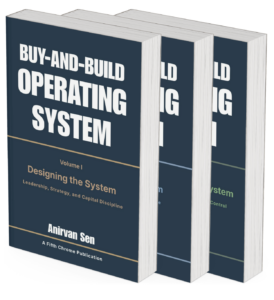
Then this book might be for you: Buy-and-Build Operating System, 3-volume set, available on all Amazon sites globally.
Visit Amazon in the US, UK, DE, FR, ES, IT, NL, JP, BR, CA, MX, AU, PL, SE, BE, IE, or IN to get your copy today.