Integration Is Operating Model Design, Not Project Management
In most acquisitions, the integration effort becomes visible within days of closing. A formal Integration Management Office (IMO) is stood up, workstreams are defined, a meeting cadence is established, and the first set of status dashboards appears. From a distance, this looks like disciplined execution.
In practice, it often marks the beginning of a familiar problem: integration is treated as a project-management exercise rather than a business-building exercise. The result is not necessarily failure in the dramatic sense, but something more common and more damaging: slow value realization, organizational fatigue, and a combined company that takes far longer than expected to operate as one.
This is not an argument against IMOs. A good IMO can materially reduce execution risk. But it is an argument against confusing the IMO with integration itself. The IMO is a coordination layer. Integration is the act of converting a transaction into a functioning, value-generating operating model.
The difference matters because coordination scales activity, while operating model convergence scales value.
The IMO solves coordination. Integration solves convergence.
An IMO exists for clarity and control. It brings structure to an inherently cross-functional problem: sequencing activities, managing dependencies, tracking risks, and maintaining a rhythm of governance. When integration is complex, geographically distributed, or heavily regulated, the IMO becomes even more essential.
But coordination is not the same as convergence.
A company can coordinate thousands of integration actions and still avoid the decisions that determine whether the acquisition compounds value. Many integrations look “on track” in dashboards while the underlying organization continues to run two different ways of working. Leaders retain legacy decision rights, systems proliferate, customers experience inconsistent handoffs, and operational friction becomes normalized. The IMO may report progress; the business experiences drag.
The problem is not that work is not being done. The problem is that the work being done does not always change the operating model.
Why activity is often mistaken for progress
This pattern persists because activity is easier to mobilize than convergence.
Workstreams can be launched quickly. Templates can be completed. Meetings can be scheduled. Dashboards can be maintained. These mechanisms provide immediate reassurance, particularly after a deal closes and the organization is under pressure to show “integration momentum.”
Operating model convergence is slower and more contentious. It requires explicit choices about how the combined company will run and who will hold power within it. Those choices are politically costly. They also surface trade-offs that many teams prefer to delay: which roles are redundant, which systems will be retired, which processes will be standardized, and which leadership behaviors will no longer be tolerated.
In this context, the IMO becomes a convenient proxy for progress. It creates visible motion while the difficult parts of integration remain unresolved.
Integration debt: the hidden cost of delayed convergence
The most damaging consequence of this confusion is what can be described as integration debt: unresolved structural and operational inconsistencies that accumulate over time and later become expensive to unwind.
Integration debt is rarely captured in a project plan. It appears in the organization as:
-
duplicated roles that persist “temporarily”
-
parallel processes that remain because standardization was deferred
-
multiple systems and reporting definitions coexisting without clear migration plans
-
unclear decision rights and informal escalation routes
-
inconsistent customer experience across legacy boundaries
-
leaders protecting legacy operating norms under the banner of “preserving what works”
None of these issues look catastrophic in isolation. Together, they erode speed, accountability, and customer confidence. More importantly, they slow the compounding effect that acquisitions are meant to produce.
The cost is not just inefficiency. It is lost time-to-value, reduced synergy capture, and weakened organizational capacity to absorb the next acquisition.
The CEO’s role is not governance. It is design.
Integration tends to drift into an IMO-led exercise when senior leadership treats integration as something that can be delegated entirely. Coordination can be delegated. Operating model design cannot.
The CEO and senior team must own a small number of decisions that determine whether the combined company becomes one system or remains a negotiated coexistence. These decisions typically fall into four categories:
1) Strategic intent
What is the acquisition intended to enable beyond scale? Market access, capability building, margin expansion, cross-sell, speed, resilience? Without clarity, integration becomes an administrative merger rather than a strategic one.
2) Operating model choices
Where will the company standardize, and where will it preserve autonomy? Which processes become enterprise-wide? Which functions must run as one from Day 1? What are the non-negotiables?
3) Leadership and decision rights
Who owns what decisions going forward? Which roles are redefined? Where will authority move, and how will conflicts be resolved? In many deals, the operating model is less constrained by technical integration than by unresolved leadership boundaries.
4) Accountability for outcomes
Integration plans often track activities, not outcomes. But value realization depends on measurable business results: revenue retention, margin improvement, cycle-time reduction, customer experience stability, and synergy capture that reaches the P&L.
Without these decisions, the IMO can maintain structure indefinitely while the business remains fragmented.
A more useful way to assess integration progress
A practical test of integration progress is whether the combined company is becoming simpler and faster, not merely more coordinated.
Boards and leadership teams can ask a short set of questions that reveal whether convergence is actually occurring:
-
Are decision rights clearer than they were at close?
-
Is the operating cadence simpler, or has it expanded through layered governance?
-
Are redundant systems being retired on schedule, or merely “stabilized” indefinitely?
-
Is the customer experience becoming more consistent across the combined entity?
-
Are synergies being realized in the P&L, not just forecasted in models?
If the answers remain ambiguous after several months, the organization is likely managing integration activity rather than building an integrated enterprise.
What to do differently: treat integration as operating system construction
The acquirers who consistently realize value do not treat integration as a set of workstreams. They treat it as an operating system build.
That means shifting emphasis from tracking actions to designing the combined business:
-
define the future-state operating model early
-
force key decisions into the first 30 to 60 days
-
assign single-point accountability for measurable outcomes
-
measure and actively pay down integration debt
-
protect the customer experience as a primary integration deliverable
-
use the IMO to create visibility and discipline, not to substitute for leadership
In other words, the IMO should be a mechanism for execution integrity, not a replacement for operating model convergence.
The point most organizations miss
The value of an acquisition is not realized when the integration plan is complete. It is realized when the combined company operates with fewer interfaces, fewer handoffs, and faster decision-making than either legacy company could achieve alone.
That is why integration is not an IMO.
An IMO can help manage complexity. But value is created when complexity is reduced—by design.
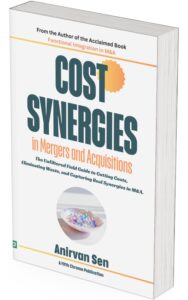
Our Latest Publication: Cost Synergies in M&A
From Framework to Field Guide
The ideas outlined above are not theoretical constructs. They are drawn directly from real integrations — across industries, geographies, and deal types — where cost synergies either compounded value or quietly eroded it.
These execution sub-elements form the backbone of my new book, Cost Synergies in M&A: The Unfiltered Field Guide to Cutting Costs, Eliminating Waste, and Capturing Real Synergies in M&A. The book catalogues every major cost synergy across the enterprise and applies this same discipline consistently — showing not just what the synergy is, but how it actually gets delivered, where it breaks, and what leaders must do differently to make it stick.
If you are involved in post-merger integration — as a CEO, CFO, integration leader, functional owner, or PE operating partner — this book is designed to sit on your desk, not your shelf.
📘 The book is now available on Amazon globally in Kindle and in Print format (some locations only have one format available).
Visit Amazon in the US, UK, DE, FR, ES, IT, NL, PL, SE, BE, IE, JP, BR, CA, MX, AU, or IN to get your copy today.
About Fifth Chrome
At Fifth Chrome, we work with CEOs, investors, and leadership teams on exactly this challenge: designing operating models that turn ambition into scalable, participatory growth.
Because the future will not belong to the biggest economies — but to the best-designed ones.
Contact Us
Visit us at fifthchrome.com for more information on our services or to schedule a consultation.