Unlike some of the large companies like Cisco, GE, Philips, Google, and others that acquire companies with constant regularity, most other companies pursue M&A as a strategy either as opportunistic or at a slower pace. Moreover, these companies do not necessarily have access to large teams supporting the process, nor do they have the clout of their brand names. They often must depend on their bankers, lawyers, and pre-deal consultants for suggestions on how to acquire and then integrate. Some of these companies may even have home-grown processes and templates.
Unfortunately, these measures fall massively short when it comes to an integration process.
I was speaking with a friend yesterday. He described their pre-deal process as heavily hinged on financial and legal due diligence and not so much on other areas. And he wished to know how to identify what other areas should they be looking at during the due diligence or post-signing stage.
Naturally, each acquisition is different. However, when it comes to the pattern and the design planning, they can be remarkably similar – just like the pre-deal stage where the processes are quite well defined.
Based on the pattern that we have observed over dozens of acquisitions in the medium to early large-size companies, we have identified several key parameters that need to be reviewed for any integration.
We have arranged these parameters in a logical 6-stage integration planning framework including organization design, integration management office, change management, culture, depth of integration, and functional calibration. You can find a detailed article on the framework here.
Now, we created a simple, quick assessment based on the same 6-stage principles.
So, first, let us share a synopsis of the 6-stages:
- Alignment on M&A integration elements: In most M&A integration projects, apart from the core team, other projects and extended team members do not have a comprehensive understanding of M&A and integration elements. This stage deals with onboarding, mobilization, creating awareness, transferring knowledge to the integration team and most importantly, getting the core team aligned on the details.
- Depth of integration: Just like leadership teams need to determine whether the acquired company is going to be tucked in, preserved, or merged, similarly every function also needs to think about the same principles. To make it worse, there are plenty of examples at a company level, where decisions are made to keep the acquired company independent, but the executive leadership demands a consolidated financial reporting, HR demands a unified appraisal and salary review cycle and IT teams may demand similar levels of information security and data protection. All these questions have an impact on the depth of integration that is required. How independent versus how interdependent functions need to be, can vary massively between integrations. And that is why integration teams must analyze these aspects upfront during an integration.
- Organization Structure and Operating Model: The third step is defining the organization structure and target operating model. While there are specific acquisitions where the acquired company is largely left alone and their operating model is “preserved,” in most acquisitions the acquired company is either absorbed or merged. In both cases, too much money is left at the table by continuing with the old independent organizational structure and unaligned operating model thus getting into bureaucratic wrangling and political ramifications. Moreover, without a unified customer journey defined not much cross-selling and up-selling happens either. Organization structures, operating models and customer journeys form a key part of the future state of the acquired organization.
- Transformation: So far, we have discussed what needs to happen in an integration. We mentioned the creation of the future organization, operating model, and customer journeys. But how is the transformation going to be achieved? This is where the transformation stage comes in. It includes Change Management, Communication, and Cultural Integration. This stage is extremely important in terms of managing people and leadership. Remember, many integrations fail due to insufficient focus on these aspects. Therefore, thorough deliberation and planning are required on these elements.
- Implementation: Once you have gone through all the critical principles of an integration, you now need to put all these elements into an implementation blueprint. Keep in mind that you may have some initial timelines and resources already chalked out. During this stage, you finalize the integration plan. You staff your integration management office, you finalize the tools and templates that you are going to use, you develop an advanced integration timeline plan and most importantly, you build a list of integration-specific objectives. By this stage, you would have also created an integration calendar, issues and escalation management as well as set up a steering committee rigor.
- Functional Calibration: Once the integration plan has been created centrally, it must be shared, socialized, and calibrated with various functions and business units. During the last stage, you need to give as much importance to individual functional components as to inter-departmental activities. Moreover, each of the functional workstreams creates their sub-project plans based on the main plan as well as informs the main team in case some adjustment needs to be made to the central plan.
This 6-stage integration planning process provides a robust framework to design any small to mid-size integration. We believe that most of the principles would be valid for large integrations as well.
The trick is not creating massive checklists with hundreds of lines but building a pattern with methodology, tools, templates, expertise, leadership, culture, and change management. This pattern allows you the flexibility to change details at the activity level and yet keeps the balance at a project level. And the biggest benefit of this framework is that allows the agility to course-correct mid-way during the project, and yet lets you get back on track but just move around a few activities.
We truly hope that these principles will bring benefit to a huge number of companies. With this goal in mind, we created our assessment scorecard. This assessment gives you instantaneous results on where the gaps are in terms of integration planning so that you can take remedial actions immediately.
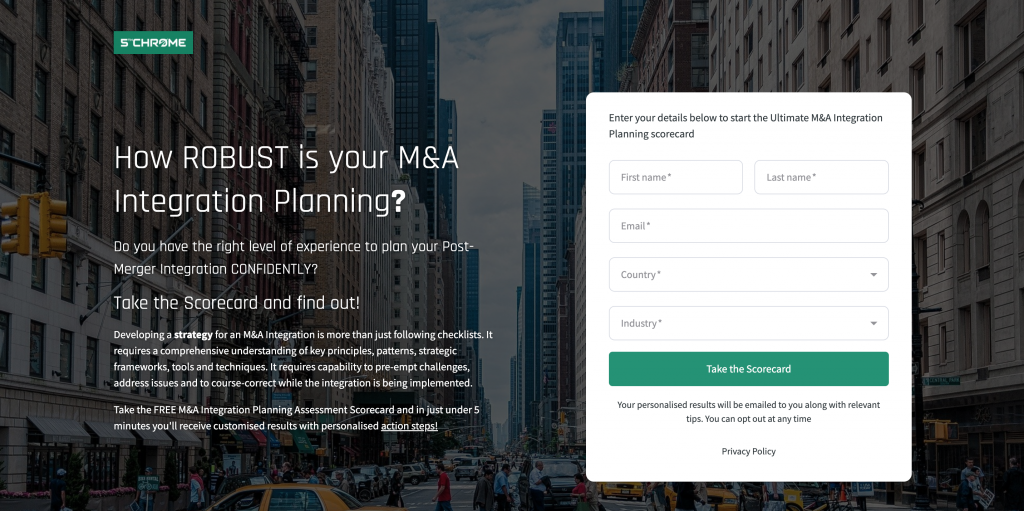
Most importantly, we have kept this assessment scorecard FREE so more organizations around the globe can get benefitted from it.
Good luck with your next M&A experience!