Buy-and-Build’s Missing Piece for Professional Services is Criticality of Sales Enablement
Anirvan Sen · September 2026
◆
You can acquire a professional-services firm full of excellent people — lawyers, consultants, accountants, architects, engineers — and still watch it struggle to generate enough revenue to keep them busy.
It happens more often than most buy-and-build investors expect, and it happens for a reason that rarely appears on a diligence checklist: being exceptionally good at delivering professional work and being able to generate that work are two entirely different capabilities. Most acquisitions test rigorously for the first. Almost none test for the second.
That gap is not a training footnote. In professional services, it is one of the most consequential — and least priced — risks in the entire buy-and-build model.
A CULTURE BUILT AROUND BILLING, NOT ORIGINATION
Walk into any law firm, accounting practice, consultancy, or architectural business, and you will find the same cultural wiring. Prestige attaches to billing. Utilization is the scoreboard. “How many hours did you bill this month?” is a more common question than “where did that client come from?”
That instinct is fine on its own terms. A good lawyer should deliver excellent legal work. A good consultant should provide excellent advice. A good accountant should be technically strong. But this culture consistently underweights one detail: before anyone can bill the work, somebody has to bring it into the firm. Delivery excellence is necessary. It is not sufficient. And in most professional-services organizations — particularly SMEs and lower-middle-market firms, which make up the bulk of buy-and-build platforms — nobody has built a systematic answer to where the next engagement comes from.
THE CONCENTRATION RISK NOBODY PRICES INTO THE DEAL
In the typical professional-services firm, only a small number of people actually own the relationships that matter. They know the clients. They hold the networks. They generate the opportunities. Everyone else is very good at fulfilling the work once it lands on their desk.
That model can run for years without visible strain. It survives ordinary staff turnover, ordinary market cycles, ordinary competitive pressure. What it does not survive well is an acquisition.
The acquiring firm hasn’t just lost a few senior people. It has lost a meaningful share of its revenue-generation capability — and that loss is invisible on the org chart.
Once the deal closes, the individuals who owned those client relationships often no longer have the incentives that drove them to originate business in the first place. Some stay but disengage. Some leave outright, taking relationships — and, in the professional-services world, sometimes clients — with them. The technical bench may be fully intact. The pipeline behind it is not.
WHY THIS HITS DIFFERENTLY IN BUY-AND-BUILD
In most operating businesses, a revenue dip after acquisition is a manageable, if unwelcome, integration cost. In professional services, it strikes at the load-bearing assumption of the entire buy-and-build thesis: that the acquired revenue base is durable enough to underwrite the multiple paid for it.
Earn-outs expire. Reporting lines change. Incentive structures get redesigned around platform economics rather than individual origination. Each of these is a normal part of integration—and each one quietly erodes the informal, relationship-based system that generated the firm’s pipeline before the deal. A year later, utilization has softened, margins have compressed, and the numbers look like a delivery problem. They are rarely a delivery problem. They are a revenue-generation problem that nobody built a systematic replacement for.
This is precisely where recruitment and talent-planning risk, and revenue-generation risk, are split into separate diligence questions. A firm can retain every technically capable person it acquired and still lose the commercial engine that made those people valuable in the first place.
THE PARTNERSHIP PARADOX
A second, quieter version of this problem is one professional-services firms tend to overlook—one that predates any acquisition and gets exposed by it.
A professional spends years being rewarded for technical excellence, delivery quality, and billable hours. Then, somewhere on the path toward partnership, the expectation changes without warning. The message becomes: you now need to generate revenue. Most partnership tracks expect meaningful origination from every partner. Very few provide any systematic preparation for it.
The convenient explanation is that certain professionals are not built to sell — that good lawyers aren’t good sellers, that accountants aren’t salespeople, that architects don’t like selling. It is a comfortable story. It is also usually wrong. The more accurate explanation is that nobody ever taught them how. Lead generation, relationship development, and opportunity creation are learnable, teachable disciplines. They are not taught with the same rigor as technical training — and in a buy-and-build platform that has just concentrated its growth expectations onto a smaller, more stretched leadership bench, that gap becomes far more expensive.
REFRAMING SALES ENABLEMENT AS A VALUE-CREATION LEVER
Most buy-and-build playbooks already treat certain capabilities as first-class value-creation levers worth systematic investment: operating rhythm, systems integration, leadership capability, financial governance. Revenue-generation capability in professional services deserves to sit on that same list — and arguably ranks above several of the others, because it is the lever that protects the revenue base every other lever is trying to scale.
A platform can have disciplined operating cadence, well-integrated systems, and a strong leadership bench, and still underperform its thesis if the underlying client-origination engine depended on two or three people who are no longer generating at the same rate. Treating sales enablement as an afterthought—something addressed informally, after the fact, if utilization numbers start to slip—treats a structural risk as a symptom to be managed rather than a cause to be designed out from the start.
FROM INDIVIDUAL RAINMAKERS TO A SYSTEMATIC ENGINE
The more useful question for a buy-and-build operator is not “which of our people are naturally good at selling?” It is “how do we systematically enable more of our professionals to generate business?”
That reframing matters at three levels simultaneously.
- For the individual professional, it turns partnership-track revenue expectations from an unspoken hurdle into a taught, practiced skill set.
- For the firm, it reduces dependence on a handful of rainmakers whose departure — voluntary or otherwise — can leave a commercial vacuum overnight.
- For the buy-and-build platform specifically, it converts a diligence blind spot into a designed-in safeguard: revenue-generation capability that survives leadership transitions rather than walking out with them.
Done well, this does not mean turning every technical professional into a full-time business developer. It means giving them a repeatable method — how to identify the right prospects, build and sustain referral relationships, nurture opportunities before they are ready to buy, and convert interest into engagements — so that origination stops being a rare personality trait and starts being an organizational capability the platform can rely on, acquisition after acquisition.
THE CLOSING REFRAME
Return to where this started. A firm can be acquired with a bench full of excellent lawyers, consultants, accountants, or architects and still fail to keep them busy — not because the talent wasn’t real, but because nobody had built a systematic way to keep opportunity flowing to that talent once the people who used to generate it were gone.
The buy-and-build operators who get professional services right will not be the ones who acquired the most talented teams. They will be the ones who treated revenue-generation capability as something to be built deliberately into the platform, rather than something they assumed would carry over with the people. Without it, growth stalls quietly, professionals drift toward lower-value work as the right opportunities stop arriving, and — in the worst cases — the jobs the acquisition was meant to protect come under pressure instead.
Sales enablement is not a soft add-on to a buy-and-build thesis in professional services. It is one of the load-bearing pieces of the thesis itself.
◆ ◆ ◆
ABOUT THE AUTHOR
Anirvan Sen is a business strategist, author, and CEO and Founder of Fifth Chrome — advising CEOs, PE investors, family offices, and Fortune 500 organizations on strategy, leadership, transformation, and M&A. He created the Buy-and-Build Operating System framework and has written multiple books on M&A, leadership, strategy, and organizational design.
Where This Conversation Can Go Next
The ideas discussed here are part of the work we do at Fifth Chrome through SCALEUP, Sales Enablement – TRAITS, and our Buy-and-Build Operating System—designed for leaders serious about building businesses that can scale, integrate, and compound.
If this resonates and you believe a deeper conversation would be valuable, you can reach us at TRAITS@fifthchrome.com or buyandbuild@fifthchrome.com.
About Fifth Chrome
At Fifth Chrome, we help companies unlock unprecedented opportunities through M&A, buy-and-build, scaling up, and leadership strategies. Whether you’re a Fortune 500 company, a mid-cap, or an SME, our expertise in M&A integration, leadership development, and strategic advisory services can help you achieve scalable growth with precision and speed.
Contact Us
Visit us at fifthchrome.com for more information on our services or to schedule a consultation.
Ready to Go Deeper?
Do you want to dive deeper into the stages of growth, their corresponding structures, leadership styles, and operational models?
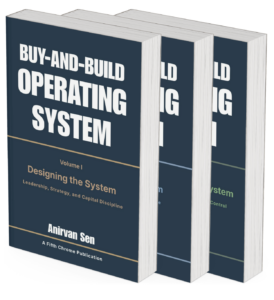
Then this book might be for you: Buy-and-Build Operating System, 3-volume set, available on all Amazon sites globally.
Visit Amazon in the US, UK, DE, FR, ES, IT, NL, JP, BR, CA, MX, AU, PL, SE, BE, IE, or IN to get your copy today.