The two-sided talent risk that most buy-and-build M&A deal models miss
Anirvan Sen · August 2026
◆
A sponsor recently described their platform’s third acquisition in eighteen months as “the deal that should have worked.” The multiple was fair, the synergy case held up, and everyone who mattered reviewed and signed off on the integration plan. What it didn’t have was anyone accountable for whether the right leaders — old or new — would still be in the building a year later. That gap, not the deal terms, is what eventually cost the platform its momentum.
Recruitment and talent planning are usually treated as a support function in a buy-and-build strategy — something HR handles once the deal closes. In practice, they are load-bearing. And the reason is not just that platforms need stronger leaders as they scale. Every acquisition brings its own talent risk on day one, whether anyone planned for it or not.
The Gap You Can See Coming
Part of the talent challenge in a buy-and-build is straightforward, even if it is often under-planned. Each acquisition adds complexity faster than it adds revenue: new reporting lines, new systems to reconcile, new cultures to fold into one operating rhythm. A leader who ran a founder-led business well at ten million in revenue is not automatically equipped to run a multi-unit platform three acquisitions later — the job has changed underneath them, even if their title hasn’t.
The mistake sponsors make here is evaluating leadership against a generic competency list rather than against what the next stage of the platform actually demands. What “good” looks like at an early, founder-led stage is not what “good” looks like once the group is scaling through acquisition — the mix of delegation, financial acumen, and cross-entity orchestration shifts materially. Get this wrong, and you either promote someone past their ceiling, or bring in outside talent too early for a business that isn’t ready to support them.
The Risk You Didn’t Buy — But Inherited Anyway
The less obvious half of the problem sits on the other side of the table: inside the company you just acquired.
Every acquisition comes with a leadership team already in place, and that team rarely survives the transition intact — or functions the way the deal model assumed it would. This shows up in three distinct ways, and sponsors who plan for only one are usually caught off guard by the other two.
The first is deliberate exit. Founder-owners in particular are often financially done at close, or shortly after an earn-out clears. Running the business inside someone else’s systems and someone else’s governance was never the plan — the sale was the plan. When they leave, they take institutional knowledge and often team loyalty with them.
The second is the leader who stays, but shouldn’t have been counted on. Some members of the acquired leadership team remain simply because no one asked them to leave — not because anyone assessed whether they were right for what the combined entity needs going forward. Sponsors inherit these leaders rather than choosing them, and the gap becomes visible only once integration is underway and the wrong person is holding a critical seat.
The third is the quietest and often the most damaging: accelerated attrition in the twelve to eighteen months after close. This isn’t the departure that gets announced at signing — it is the slow leak that follows once the initial adjustment period ends, new reporting lines start to bite, and cultural friction with the acquirer’s systems sets in. Because it isn’t visible at close, it rarely gets planned for, and by the time it shows up in the numbers, it has already cost the platform stability at precisely the point integration needs it most.
Why This Breaks the Deal Thesis
A deal thesis is executed by people, not by the model that justified it. Weak bench strength — whether on the acquiring side or the acquired side — is one of the most common reasons buy-and-build value creation stalls after signing, and it rarely gets named as the cause. It gets attributed to “integration challenges” or “cultural fit issues,” when the real driver is that nobody had a plan for who would actually be running things a year in.
The Operating Model This Actually Requires
This is not a workload a generalist HR function can absorb at its normal pace. Buy-and-build talent planning runs on deal speed and deal stakes — assessing a leadership team during a diligence window measured in weeks, then executing succession and backfill plans in parallel with integration, deal after deal. That is a specialized, high-pressure discipline, not an addition to an existing HR mandate.
This is why more sponsors are bringing in a fractional or interim CHRO, or a specialized talent advisory partner, to run this function at the pace the platform demands — someone whose full mandate is leadership assessment and succession planning across the deal pipeline, rather than a generalist stretched across payroll, benefits, and everything else.
Just as important is where this function reports. Talent risk at this level is too consequential to sit several layers down a functional reporting line, where it competes for attention with routine HR administration. It needs direct line of sight to the PE firm, the operating partner, or the CEO — the people actually accountable for the platform’s returns — so that a leadership gap surfaces as a deal risk the moment it’s identified, not months later as a surprise.
The Bottom Line
Recruitment and talent planning are not a support function to a buy-and-build strategy — they are a load-bearing part of it, on both sides of every deal. The platform’s forward capability matters. But so does the leadership team you just acquired, whether or not it survives the transition intact. Sponsors who resource this properly — with dedicated expertise and a direct line to the people who own the outcome — are the ones who find out the deal thesis was right, not the ones who discover, eighteen months later, that it never had a chance.
◆ ◆ ◆
ABOUT THE AUTHOR
Anirvan Sen is a business strategist, author, and the CEO and Founder of Fifth Chrome — advising CEOs, PE investors, family offices, and Fortune 500 organizations on strategy, leadership, transformation, a nd M&A. He created the Buy-and-Build Operating System framework and has written multiple books on M&A, leadership, strategy, and organizational design.
Where This Conversation Can Go Next
The ideas discussed here are part of the work we do at Fifth Chrome through SCALEUP and our Buy-and-Build Operating System — designed for leaders who are serious about building businesses that can scale, integrate, and compound.
If this resonates and you believe a deeper conversation would be valuable, you can reach us at scaleup@fifthchrome.com or buyandbuild@fifthchrome.com.
About Fifth Chrome
At Fifth Chrome, we specialize in helping companies unlock unprecedented opportunities through M&A, buy-and-build, scaling up, and leadership strategies. Whether you’re a Fortune 500 company, a mid-cap, or an SME, our expertise in M&A integration, leadership development, and strategic advisory services can help you achieve scalable growth with precision and speed.
Contact Us
Visit us at fifthchrome.com for more information on our services or to schedule a consultation.
Ready to Go Deeper?
Do you want to dive deeper into the stages of growth, their corresponding structures, leadership styles, and operational models?
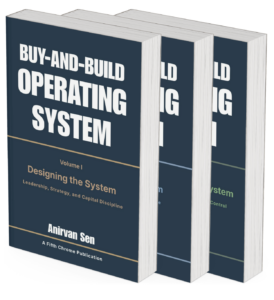
Then this book might be for you: Buy-and-Build Operating System, 3-volume set, available on all Amazon sites globally.
Visit Amazon in the US, UK, DE, FR, ES, IT, NL, JP, BR, CA, MX, AU, PL, SE, BE, IE, or IN to get your copy today.