Why Buy-and-Build Strategies Scale Companies Without Making Them Grow
Anirvan Sen · July 2026
◆
Imagine a platform company that acquires four businesses over three years. Revenue climbs from $20 million to $65 million. The board celebrates. The investment committee congratulates management. The CEO stands in front of the portfolio review and talks, with justified pride, about a successful buy-and-build strategy.
Then someone on the committee asks a question that is rarely asked, and even more rarely answered with confidence.
How much of that additional $45 million was actually created after the acquisitions closed?
In most platforms, the honest answer is: almost none of it. The business became larger. It did not become better at growing. And in buy-and-build, those two outcomes are routinely mistaken for one another — with consequences that compound quietly for years before anyone notices them on a value bridge.
◆ ◆ ◆
THE HIDDEN ASSUMPTION
Every acquisition brings revenue with it. But that revenue already existed before the deal closed. The acquirer is buying existing clients, existing relationships, existing sales capability, and an existing reputation in the market. Very little of the revenue on day one was newly created by the transaction itself.
Acquisition creates scale. It does not, on its own, create growth.
That distinction sounds obvious stated plainly. It is almost never applied plainly, because the revenue line on the consolidated rarely distinguishes between the two. A dollar of acquired revenue and a dollar of newly created revenue look identical in the reporting pack. They are not identical in what they say about the business.
◆ ◆ ◆
THE COMMERCIAL BLIND SPOT
This is where many portfolio companies get caught. The integration plan is usually excellent on the dimensions that are easy to plan for: finance is integrated, HR is integrated, IT is integrated, branding is integrated, procurement is integrated.
Yet almost nobody in the 100-day plan asks the one question that determines whether the platform will actually grow: who, specifically, is responsible for creating the next €10 million?
The default assumption is that the acquired partners, founders, or salespeople will simply continue producing as they did before the deal. And for a while, usually do. Founders stay engaged through their earn-out. Legacy relationships hold. The commercial engine appears to be running fine, because nobody has yet asked it to do anything it was not already doing.
◆ ◆ ◆
THE REAL PROBLEM: INHERITED CAPABILITY IS NOT BUILT CAPABILITY
Buy-and-build firms usually inherit sales capability. They rarely build sales capability. Those are two entirely different things, and the difference between them is the single distinction that determines whether enterprise value compounds or stagnates over the hold period.
Inherited capability leaves with people. It sits in the heads and relationships of specific founders and senior sales figures, and when they exit — whether at the end of an earn-out, through attrition, or simply through fatigue after a long integration — the capability leaves with them.
Built capability stays with the organisation. It is encoded in a repeatable sales process, in CRM, in opportunity governance, in a forecasting cadence, in account planning, in a functioning lead-generation system, in a recruitment pipeline for sales talent, and in a coaching capability that develops the next generation of sellers rather than relying on the current one indefinitely.
| Every acquisition delivers bought revenue. Very few organisations know how to create built revenue. |
◆ ◆ ◆
THE CONSEQUENCE: organizations become larger every year. Yet, examined unit by unit, most business units are growing organically at only one to three percent. New acquisitions become the only meaningful source of growth on the consolidated numbers.
Eventually the sponsor has to keep buying simply to maintain momentum, because the acquisition engine has quietly become a substitute for the commercial engine rather than a complement to it. This is not a failure of deal-making. It is a failure to professionalize the one function that was expected, by default, to keep performing on its own.
◆ ◆ ◆
WHY THIS HAPPENS
Commercial infrastructure is rarely professionalized with the same rigor applied to finance, rarely during integration. There is often no repeatable sales process, no CRM discipline, no opportunity governance, no sales management cadence, no forecasting discipline, no account planning, no lead generation system, no recruitment pipeline for sales talent, and no coaching capability.
Revenue, as a result, depends on individuals rather than on systems. That dependency is invisible on the way in—deals close, the founder is engaged, the numbers hold—and becomes expensive only on the way out, when the individuals who were carrying the commercial function leave, and there is no system. There them to catis then a fall to catchHE EXPENSIVE MISTAKE: TWO NUMBERS THAT LOOK IDENTICAL AND AREN’T
When executives review revenue after an acquisition, they typically celebrate a single number. They rarely separate that number into its two real components: acquired revenue and created revenue.
Acquired revenue measures capital deployment. Created revenue measures management capability. A board or an investment committee that tracks only the combined figure is, in effect, measuring how much was spent rather than how well the business is being run. Both numbers matter. Only one of them tells you whether the operating model is actually working.
◆ ◆ ◆
THE THRESHOLD THAT ACTUALLY MATTERS
Even once a business separates acquired revenue from created revenue, one more question tends to go unasked: how much organic growth is actually meaningful?
A low single-digit organic growth rate is not really growth once the cost of capital, the cost of management attention, and the cost of integration are accounted for. It is a business standing still while looking, on paper, as though it is moving forward. Real, value-creating organic growth needs to clear a materially higher bar — comfortably into double digits — before it is doing more than covering the drag of running the platform itself.
This is the uncomfortable arithmetic that acquisition-led growth quietly hides. A platform can report double-digit consolidated growth every year and still be organically flat, because the acquisitions are doing all of the work the commercial engine should be doing on its own. Boards that track only the consolidated number rarely see this. Boards that set an explicit organic growth hurdle — and hold the operating team to it, separately from deal-driven growth — see it immediately.
◆ ◆ ◆
THE SHIFT
The governing question in most portfolio reviews is still: how many businesses did we acquire? The more useful question — and the one that should sit alongside deal count on every board pack — is: how much new revenue did our operating model create?
The second question determines enterprise value at exit, because multi-year demonstrated organic growth far more durably rewards a track record of acquisitions than a track record of acquisitions alone.
◆ ◆ ◆
WHERE THE BUY-AND-BUILD OPERATING SYSTEM FITS
This is precisely the gap the Buy-and-Build Operating System framework is built to close. Commercial capability-building sits alongside the other operating disciplines — leadership scaling, integration governance, and operating rhythm — as one of the levers that determines whether a platform compounds value or simply compounds size.
Within that framework, professionalizing the commercial engine is treated as a stage-specific discipline rather than a one-time integration task. What a Founder-Led Base platform needs from its commercial infrastructure is different from what a platform approaching Institutionalization needs, and the operating system is designed to make that distinction explicit rather than leave it to instinct.
◆ ◆ ◆
WHAT NEEDS TO CHANGE
Professionalizing commercial growth means applying the same discipline already applied to finance and operations. In practical terms, that means building a genuine commercial operating system: sales leadership, a recruitment engine for sales talent, structured onboarding, playbooks, coaching, governance, KPIs, and accountability, alongside a scalable business development capability that does not depend on any single individual staying in place.
This is not because sales, as a function, is broken. It is because acquisitions do not create organic growth. Commercial systems do.
| TWO QUESTIONS FOR THE NEXT PORTFOLIO REVIEW
— Of this year’s revenue growth, how much was acquired and how much was created — and can we actually show the split? — If our top three legacy sales relationships left tomorrow, what would carry the pipeline in their absence? |
◆ ◆ ◆
CLOSING THOUGHT
Perhaps the most persistent misconception in buy-and-build is the belief that acquisitions are, in themselves, a growth strategy. They are not. They are a scaling strategy. Growth still has to be engineered, deliberately and separately, after the transaction closes.
Until portfolio companies learn to build commercial capability — rather than acquire revenue — they will continue to confuse size with value. The two are not the same thing, and the businesses that eventually separate them are the ones that compound.
◆ ◆ ◆
ABOUT THE AUTHOR
Anirvan Sen is a business strategist, author, and the CEO and Founder of Fifth Chrome — advising CEOs, PE investors, family offices, and Fortune 500 organizations on strategy, leadership, transformation, a nd M&A. He is the creator of the Buy-and-Build Operating System framework and the author of multiple books on M&A, leadership, strategy, and organizational design.
Where This Conversation Can Go Next
The ideas discussed here are part of the work we do at Fifth Chrome through SCALEUP and our Buy-and-Build Operating System — designed for leaders who are serious about building businesses that can scale, integrate, and compound.
If this resonates and you believe a deeper conversation would be valuable, you can reach us at scaleup@fifthchrome.com or buyandbuild@fifthchrome.com.
About Fifth Chrome
At Fifth Chrome, we specialize in helping companies unlock unprecedented opportunities through M&A, buy-and-build, scaling up, and leadership strategies. Whether you’re a Fortune 500 company, a mid-cap, or an SME, our expertise in M&A integration, leadership development, and strategic advisory services can help you achieve scalable growth with precision and speed.
Contact Us
Visit us at fifthchrome.com for more information on our services or to schedule a consultation.
Ready to Go Deeper?
Do you want to dive deeper into the stages of growth, their corresponding structures, leadership styles, and operational models?
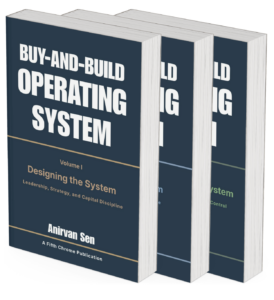
Then this book might be for you: Buy-and-Build Operating System, 3-volume set, available on all Amazon sites globally.
Visit Amazon in the US, UK, DE, FR, ES, IT, NL, JP, BR, CA, MX, AU, PL, SE, BE, IE, or IN to get your copy today.