The Real Problem with M&A Integration Isn’t Culture—It’s Operating Systems
When mergers and acquisitions fail to deliver their promised value, culture is the most convenient scapegoat. We tell ourselves the cultures didn’t align. That the acquired company resisted change. That the people “weren’t ready” for scale. These explanations are neat, familiar, and—more often than not—wrong.
After years of advising on integrations across industries and deal sizes, I’ve come to a sharper conclusion. The real problem is not culture. It is operating systems. And more precisely, it is the acquirer’s unexamined belief that their operating system is the only legitimate one.
When a CEO Becomes “Middle Management”
Consider a situation I have seen more than once. A large corporate organization acquires a smaller, fast-growing business. As part of the deal, the acquired company’s CEO is retained. On paper, this signals continuity and respect. In practice, something else unfolds.
The acquiring leadership looks at the organizational chart and draws a quiet conclusion: CEO of a small company equals middle management in our world. Reporting lines are redrawn. Decision rights are narrowed. Corporate approval mechanisms are imposed. Governance processes that evolved to manage scale and risk are applied wholesale.
From the acquirer’s perspective, this feels professional. Disciplined. Mature.
From the acquired CEO’s perspective, it feels like suffocation.
What the acquirer fails to recognize is that this individual was not simply holding a title. He was running a fundamentally different system. He made decisions quickly because delay was existential. He wore multiple hats because specialization came later. He stayed close to the market because that was where survival and growth were decided. His authority was not ornamental; it was operational.
This was not a mismatch of seniority. It was a collision between two operating systems built for entirely different realities.
The Real Nature of Integration Friction
When this kind of integration starts to creak, culture is blamed. The entrepreneurial leader is described as chaotic. His pace is labeled reckless. His insistence on autonomy is interpreted as resistance.
In truth, none of this is cultural. It is structural.
Early-stage and entrepreneurial businesses are designed to find and exploit opportunity. Their operating rhythm prioritizes speed, adaptability, and learning. Mature corporations are designed to preserve and scale value. Their systems prioritize predictability, control, and risk management.
Neither is superior. Each is fit for purpose in its own context.
Problems arise when the acquiring organization assumes that maturity automatically confers correctness. When its leaders believe—often unconsciously—that professionalism has a single definition, and that definition happens to look exactly like their own organization.
This is not malice. It is arrogance of a quieter kind: the arrogance of normalization. The belief that our way is simply the way.
What Gets Destroyed in the Process
The tragedy is not interpersonal friction. It is value destruction.
The very qualities that justified the acquisition—speed, customer intimacy, entrepreneurial judgment—are steadily eroded. Decision cycles lengthen. Accountability blurs. The acquired leadership disengages or exits. What remains is a sanitized version of the business, neatly integrated and strategically diminished.
And then, months later, the post-mortem concludes: the culture didn’t scale.
What Sophisticated Acquirers Do Differently
A Chairman-grade view of integration starts from a different premise: when you acquire a company, you are acquiring a system, not just assets and people.
That demands a different discipline.
First, operating systems must be mapped before they are merged. Not at the level of values statements, but at the level of real behavior. How are decisions actually made? How is talent developed? How close is leadership to the market? What is the true cadence of execution? This requires observation, not workshops.
Second, the instinct to homogenize must be resisted. Standardization has its place, but indiscriminate alignment is lazy integration. The harder, more valuable work is deciding what must converge and what should remain distinct because it is a source of advantage.
Third, entrepreneurial leadership must be preserved deliberately. If the acquisition thesis depends on agility or innovation, retained leaders need genuine autonomy within defined boundaries. Not symbolic titles. Real decision rights.
Fourth, translation layers must be built. Large organizations and entrepreneurial businesses speak different managerial languages. Leaders who understand both systems are not a luxury; they are essential infrastructure.
Finally, and most uncomfortably, acquirers must interrogate their own assumptions. Not “how do we professionalize them?” but “what are they doing that we no longer know how to do?” That single reframing separates learning organizations from value destroyers.
The Real Work of Integration
Integration is not a culture exercise. It is a systems exercise.
You are not bringing together two sets of people who need to like each other more. You are bringing together two machines running different software, designed for different stages of the business lifecycle.
The job of leadership is not to overwrite one system with another. It is to understand both, preserve what makes each effective, and design the interfaces that allow them to coexist without grinding each other down.
Most acquirers do not fail because they are arrogant in intent. They fail because they are blind to their own operating logic—and because they mistake difference for deficiency.
That blindness, more than any so-called culture clash, is where M&A value quietly disappears.
Where This Conversation Can Go Next
The ideas discussed here are part of the work we do at Fifth Chrome through SCALEUP and our Buy-and-Build Operating System — designed for leaders who are serious about building businesses that can scale, integrate, and compound.
If this resonates and you believe a deeper conversation would be valuable, you can reach us at scaleup@fifthchrome.com or buyandbuild@fifthchrome.com.
About Fifth Chrome
At Fifth Chrome, we specialize in helping companies unlock unprecedented opportunities through M&A, buy-and-build, scaling up, and leadership strategies. Whether you’re a Fortune 500 company, mid-cap, or SME, our expertise in M&A integration, leadership development, and strategic advisory can help you achieve scalable growth with precision and speed.
Contact Us
Visit us at fifthchrome.com for more information on our services or to schedule a consultation.
Ready to Go Deeper?
Do you want to dive deeper into the stages of growth, their corresponding structures, leadership styles, and operational models?
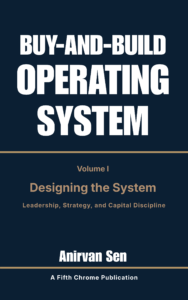
Then this book might be for you: Buy-and-Build Operating System Volume 1, available on all Amazon sites globally.
Visit Amazon in the US, UK, DE, FR, ES, IT, NL, JP, BR, CA, MX, AU, PL, SE, BE, IE, or IN to get your copy today.