Why Naming Synergies Is Easy — and Executing Them Is Not
Most M&A failures are not caused by a lack of synergy ideas.
They are caused by undeveloped synergy thinking.
Organizations routinely say they will “capture IT synergies,” “rationalize headcount,” or “optimize procurement.” These phrases sound decisive, but they are dangerously incomplete. A synergy that is named but not characterized is not a plan — it is a hope wrapped in a spreadsheet.
Cost synergies only become executable when they are fully described across a consistent set of execution dimensions. Anything less leaves value exposed to delay, politics, and operational fragility.
Below is why every synergy lever must be explicitly characterized across the following sub-elements, and what breaks when it is not.
1. Savings Potential
Why it matters
Without defining where the money actually comes from, synergies remain abstract. Many integrations fail not because savings are impossible, but because teams cannot articulate which cost line disappears, when, and why.
Characterizing savings potential forces clarity on:
-
The true source of savings (headcount removal, license elimination, contract renegotiation)
-
Why the synergy is financially material, not just visible
-
Its realistic contribution to SG&A or the cost base, net of transition cost
This prevents the most common failure mode: double-counted, overestimated, or structurally impossible savings.
2. Realization Timeline
Why it matters
All synergies do not move at the same speed — but most plans assume they do.
Mapping each synergy to the 7 stages of integration forces realism:
-
What can happen early without destabilizing operations
-
What must wait for systems, governance, or leadership clarity
-
What sequencing constraints are non-negotiable
When timing is not explicit, leaders push too fast or hesitate too long — both destroy value. Discipline here protects credibility and operational stability.
3. Resources Required
Why it matters
Synergies do not execute themselves.
Every synergy consumes leadership attention, functional capacity, and PMO bandwidth. Characterizing resources required clarifies:
-
Which functions truly own execution
-
Where leadership decisions are required versus functional delivery
-
The capability intensity involved (HR-heavy, IT-heavy, Legal-heavy, etc.)
This avoids the silent killer of integration plans: unfunded execution.
4. Key Risks and Dependencies
Why it matters
Most synergies fail for predictable reasons but those reasons are rarely documented upfront.
Explicitly naming:
-
What commonly breaks execution
-
Structural, system, legal, or talent dependencies
-
Interlocks with other synergies
…turns risk from a post-mortem topic into a design input.
When dependencies are invisible, teams unknowingly block themselves and blame execution rather than architecture.
5. Integration Debt (Cost of Delay)
Why it matters
Not acting is also a decision, and it is rarely neutral.
Characterizing integration debt makes the cost of postponement explicit:
-
How inefficiency becomes normalized
-
How duplicated cost embeds themselves into budgets
-
Why late action costs more financially, politically, and culturally
This reframes synergy execution from “optional improvement” to time-sensitive value protection.
6. Stakeholders
Why it matters
Synergies are not resisted by organizations.
They are resisted by people with influence.
Explicit stakeholder mapping surfaces:
-
Who is directly impacted
-
Who can accelerate or silently block execution
-
Where political or emotional resistance will appear
Ignoring this dimension leads to technically sound plans that stall without explanation.
7. Constraints
Why it matters
Some things simply cannot move at leadership speed.
Labor laws, regulatory approvals, contracts, systems, and culture impose real limits. Naming constraints upfront:
-
Prevents false commitments
-
Protects leadership credibility
-
Enables intelligent sequencing instead of frustration-driven escalation
Constraints do not weaken synergy plans – pretending they don’t exist does.
8. Things to Watch Out For
Why it matters
Many integrations appear successful on paper while delivering little real value.
Calling out execution traps helps teams avoid:
-
Cosmetic actions that don’t remove cost
-
False efficiencies that shift cost elsewhere
-
“Temporary” workarounds that become permanent
This sub-element separates activity from outcome.
9. Special Considerations
Why it matters
Not all deals behave the same.
PE-backed acquisitions, carve-outs, capability buys, cross-border deals, and regulated industries each distort execution in different ways. This lens ensures:
-
The synergy approach matches the deal logic
-
Cultural and geographic realities are respected
-
Best practices are adapted, not blindly copied
Generic execution fails in specific contexts.
10. Metrics
Why it matters
What is not measured drifts. What is poorly measured deceives.
Defining metrics ensures:
-
Clear tracking of progress and value realization
-
Balance between financial and operational health
-
Visibility into leading vs lagging indicators
Without metrics, synergies exist only in decks — not in P&L reality.
The Real Point
Cost synergies are not difficult because they are complex.
They are difficult because they are incompletely defined.
Characterizing every synergy across these sub-elements transforms integration from reactive cost-cutting into deliberate operating-model design. It replaces optimism with structure, speed with sequencing, and pressure with discipline.
Synergies do not fail because teams lack ambition.
They fail because ambition is not translated into executable clarity.
This framework is how that translation happens.
From Framework to Field Guide
The ideas outlined above are not theoretical constructs. They are drawn directly from real integrations — across industries, geographies, and deal types — where cost synergies either compounded value or quietly eroded it.
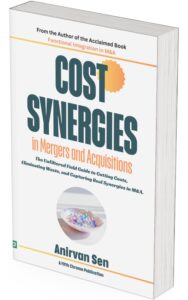
These execution sub-elements form the backbone of my new book, Cost Synergies in M&A: The Unfiltered Field Guide to Cutting Costs, Eliminating Waste, and Capturing Real Synergies in M&A. The book catalogues every major cost synergy across the enterprise and applies this same discipline consistently — showing not just what the synergy is, but how it actually gets delivered, where it breaks, and what leaders must do differently to make it stick.
If you are involved in post-merger integration — as a CEO, CFO, integration leader, functional owner, or PE operating partner — this book is designed to sit on your desk, not your shelf.
📘 The book is now available on Amazon globally in Kindle and in Print format (some locations only have one format available).
Visit Amazon in the US, UK, DE, FR, ES, IT, NL, PL, SE, BE, IE, JP, BR, CA, MX, AU, or IN to get your copy today.
About Fifth Chrome
At Fifth Chrome, we work with CEOs, investors, and leadership teams on exactly this challenge: designing operating models that turn ambition into scalable, participatory growth.
Because the future will not belong to the biggest economies — but to the best-designed ones.
Contact Us
Visit us at fifthchrome.com for more information on our services or to schedule a consultation.