You trained for years to
become excellent at your craft.
Nobody ever trained you to sell.

Six Stages. One Warm Ecosystem.
An engine that keeps producing sales pipeline
— built once, running for good.

The Problem

Revenue unpredictability isn’t bad luck. It’s the default.

The consequences of never having been trained to sell — not because you’re doing anything wrong, but because nobody ever gave you a process for it.

  • Your pipeline runs on chance, not a schedule: Some months are full, some are empty — and there’s no way to see which one’s coming, because nothing about how work arrives is within your control.
  • You’re hostage to word-of-mouth: Referrals show up when someone else happens to think of you. You can’t control when that happens or how often—so volume is whatever people volunteer, not what the relationship could actually produce.
  • Feast and famine become a cash flow problem: When revenue doesn’t arrive on a predictable rhythm, neither does the working capital to run the practice — hiring, overhead, and growth all get harder to plan around income you can’t forecast.

Business leadership discussions on how to scale up
The Framework at a Glance

Six stages, one repeatable cycle

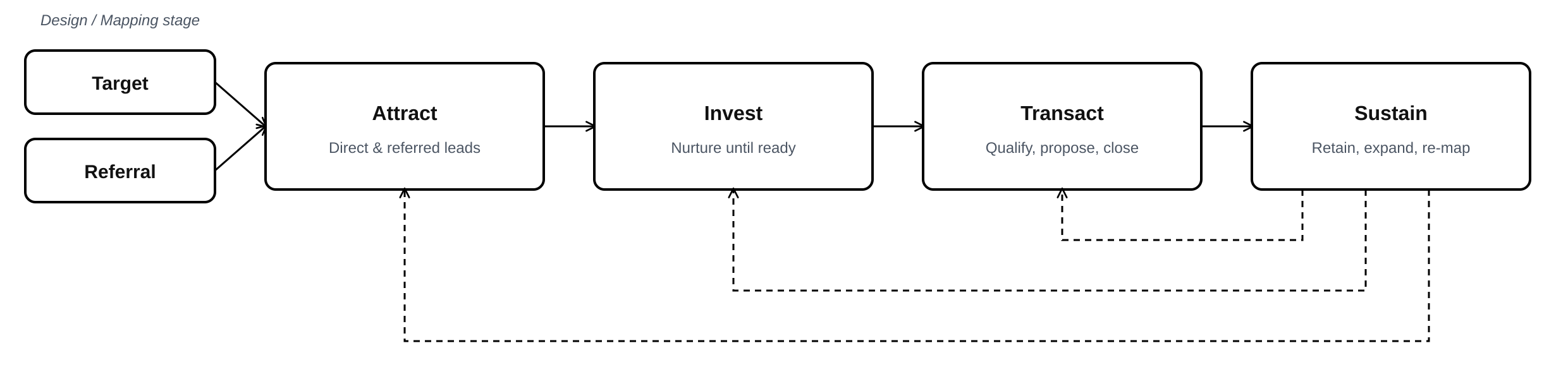
Target and Referral run in parallel, both feeding new prospects into Attract. From there it’s linear through Invest, Transact, and Sustain — and Sustain feeds back into all three of the stages before it, depending on what’s true of the client.

Dashed lines: referral (→ Attract), cross-sell/upsell (→ Invest), repeat purchase (→ Transact).

T.R.A.I.T.S. - The Six Stages Explained

Stop chasing anyone who’ll take a meeting. Know exactly who you’re building this engine for.
This includes:

  • Defining your Ideal Client Profile (ICP) — the specific traits, industry, size, and pain points that mark a genuine fit
  • Building a value proposition ladder that matches what different tiers of that ICP actually need
  • Creating a qualification checklist so “good fit” isn’t a gut call
  • Documenting where your best past clients actually came from, and what they had in common

Identify exactly who can introduce you — before you start reaching out to anyone.
This includes:

  • Mapping your network for people who know, trust, and are potentially connected to your Target profile
  • Segmenting referral sources by how warm the relationship is and how well-positioned they are to introduce you
  • Defining what makes someone a strong referral source, with the same rigor you’d apply to defining an ICP
  • Prioritizing which referral sources to approach first, based on fit and reach

This is where design becomes action — for direct targets and referral sources alike, the outreach starts here, and it starts the same way.
This includes:

  • Reaching out directly to prospects who match your Target profile
  • Opening relationships with the referral sources you identified — not asking for an introduction yet, just starting the relationship
  • Building one repeatable outreach cadence that covers both, so neither depends on you remembering to follow up
  • Setting clear criteria for when someone — direct prospect or referral source — is warm enough to move into Invest

Nurture direct prospects toward readiness — and referral sources toward the introduction they haven’t made yet.
This includes:

  • Building trust with direct prospects until they’re actually ready to buy, not before
  • Staying close to referral sources long enough that they think of you the moment the right opportunity appears
  • Recognizing the moment a referral source actually introduces a real prospect — a target referral — and moving that person into their own Attract cycle from the start
  • Creating a CRM and pipeline setup that tracks both kinds of relationship without conflating them

Turn a Plunge Signal into work that’s actually delivered, billed, and paid — not just a signed contract.
This includes:

  • Qualifying the request and shaping a proposal around exactly what earned it
  • Negotiating terms, managing the contract, and closing cleanly
  • Delivering the work, billing on schedule, and collecting what’s owed — with a clear path for chasing payment that stalls
  • Feeding the finished engagement back into your Rearview Audit, so it sharpens who and how you target next

The client relationship doesn’t end at delivery — it becomes the source of your next three moves.
This includes:

  • Managing the post-sale experience and surfacing genuine cross-sell and upsell opportunities as they arise
  • Converting satisfied clients into referral sources, and re-mapping your Target and Referral profiles as your book of business evolves
  • Refreshing your own sales tactics, tools, and templates — staying sharp on your side, not just managing the client
  • Routing what happens next correctly: a referral goes back into Attract as a new lead, a cross-sell or upsell goes back into Invest, a client ready to buy again goes straight back into Transact.
Why It Works

Business development, treated as a system


  • T.R.A.I.T.S. treats business development the way an operations leader treats a supply chain: as a system with defined stages, inputs, and feedback loops — not a talent some people happen to have and others don’t.

  • That’s a deliberate choice. Most growth advice for professional services firms focuses on one stage in isolation — better proposals, better follow-up, better referral asks — without addressing how each stage feeds the next, or what happens to a client after the deal closes.


  • Most professional services firms don’t fail at business development because they lack skill in any one stage. They fail because they lack structure across all of them: a referral network nobody actually manages, a single lead source with no fallback when it slows, relationships that exist only to close one transaction with no maintenance phase after, no repeatable way to generate volume, and no real ecosystem around the practice. Fixing one of these in isolation still leaves the others capping your growth. T.R.A.I.T.S. is built to close all five at once — not whichever one happens to be top of mind this quarter.

  • It’s also why Invest carries as much structure as it does, rather than being treated as the gap between a good conversation and a signed deal. Most prospects are only in active buying mode a small fraction of the time — show up with a pitch outside that window and you mostly just burn the relationship. A system that stays present during the rest of that time makes you the obvious call when the moment to buy arrives, instead of hoping you’re remembered.

Built on real experience

Built by Someone Who's Actually Been in the Trenches

Anirvan Sen, Founder and CEO of Fifth Chrome, built T.R.A.I.T.S. from direct, hands-on experience — not a framework borrowed from a textbook.

Globally Relevant

Patterns that repeat across 80+ countries and 100+ industries.

Size Agnostic

Advised everyone from Fortune 500 firms to solo practitioners.

Array of Sectors

Scaled engineering, law, consulting, and accounting firms

Experience Reach

Thousands of real conversations, not slide-deck case studies.

How We Can Help

Mini-workshop

2-3 hours

See T.R.A.I.T.S. in Action. Watch the method applied to a real practitioner’s business, live, in under three hours — no pitch, no pressure, just the framework at work, so you can judge for yourself whether it’s worth going deeper.

Book

Coming Soon

Read the Full Method. The complete T.R.A.I.T.S. framework, chapter by chapter — every stage, every tool, and the thinking behind why it’s built this way. Get notified the moment it’s available, and be among the first to read it.

90-Day Acceleraror Cohort

For Practitioners

Build Your Own Engine. A 90-day guided program where you build your actual T.R.A.I.T.S. system alongside your own practice — your ICP, your referral network, your outreach cadence — not a theoretical exercise, a working engine by the end of it.

Team Training

For Firms and Teams

Bring It to Your Team. A training format built around how your firm actually works, not a generic off-the-shelf course — so growth stops depending on any one person’s instinct and starts running as a system everyone can use.